
All-New Flagship 3-Row SUV
The flagship tag can mean any number of things. In its purest form, it means something is the best a company has to offer. In the case of Hyundai, they want the goodness of all-electric 2026 Ioniq 9 to seep down to all the models in its line-up.
Welcome to the new flagship for Hyundai.
What Is the Ioniq 9?
The Ioniq 9 moves to the top of Hyundai’s family of SUVs by size. The group now goes from small-to-large—Venue, Kona, Tucson, Ioniq 5, Nexo, Santa Fe and Palisade. A variety of propulsion options are offered, but the all-electric three-row Ioniq 9 is the largest emissions-free SUV from Hyundai.
Ioniq 9: Two Power Options
- Rear-wheel drive (RWD)
- Single electric motor
- 110 kWh lithium-ion polymer battery
- Horsepower: 215
- Torque (pound-feet): 258
- 0-60 mph, estimated 5.5 seconds
- All-electric range (AER): 335 – Long Range trim
- Towing, with trailer brakes: 3,500 pounds
- All-wheel drive (AWD)
- Dual electric motors
- 110 kWh lithium-ion polymer battery
- Horsepower options: 303 or 422
- Torque (pound-feet): 516
- 0-60 mph, estimated 4.4 seconds
- All-electric range (AER): 311-320
- Towing, with trailer brakes: 5,000 pounds
Charging
The 2026 Hyundai Ioniq 9 comes standard with a NACS (Tesla) charging port and an adapter (included with new vehicle purchase) allowing owners the option of using CCS chargers.
The Ioinq 9, with its 800-volt electrical architecture, has a battery conditioner to improve charging and performance by heating or cooling the battery to the optimal charging temperature. It can be trickle-charged with a 120V common wall plug, but expect replenish times to be long and slow. The best bet for owners will be to install a Level 2 240V home charger that will take the battery from 10-to-100% in 9.4 hours, or approximately overnight.
DC fast-charging at a NACS V3 Supercharger takes 41 minutes to go from 10-to-80%. Using the CCS adapter at 50 kW public charger will take 109 minutes, but at a 350 kW one it only takes 24 minutes.
The Ioniq 9 has Vehicle-to-Load, or V2L, where power can flow out of the battery and charge e-bikes, power tire pumps and outdoor equipment, run your office while traveling, and even be an electricity source for a home during a power outage.
Complimentary Home Charger or Charging Credit
Customers who purchase or lease a new 2026 Hyundai Ioniq 9 are eligible for their choice of a ChargePoint Home Flex Level 2 residential charging station or a $400 charging credit. Hyundai will provide the home charger through its Hyundai Home Marketplace which will also assist customers with scheduling professional installation. The charging credit can be used through Hyundai Pay at participating stations, which currently include ChargePoint, EVgo and Electrify America.
Silent and Smooth Cruising
Clean Fleet Report spent a week in-and-around Southern California driving two Ioniq 9 trims, a total of 412 miles. We first were in the Ioniq 9 AWD Performance Calligraphy for 285 miles and then the AWD Performance Limited for 127 miles. The 422 horsepower and 516 pound-feet of torque were more than plenty to move the 6,008-pound seven-passenger SUV. The torque came on instantly, and there was no engine to stumble or multi-gear transmission to search for the right gear. It made for an enjoyable, premium drive. If you have never driven an electric car, put it on your to-do list for next week.
The weather conditions were such I only used the Eco, Normal and Sport drive modes, leaving Snow and the customizable My Mode for another day. Eco is best for maximizing fuel economy when on the open road, but Sport gave the Ioniq 9 more spirit by changing the throttle response and steering sensitivity. Normal is the happy medium mode.
The AWD system, with dynamic torque vectoring and lateral wind stability control, delivered excellent handling for a vehicle that feels smaller than it looks. It was nimble with no hint of tire slippage, body roll or any lack of control when pushing hard around tight or sweeping corners. The floor-mounted batteries drop the center of gravity, making for sure-footed handling.
Two technologies that Hyundai does as good or better than any brand are its paddle shifter-operated Regenerative Braking and one pedal/i-Pedal driving. Mastering them (a very short learning curve) creates the easiest and most enjoyable way to drive an electric car. Make sure to have the Hyundai dealer sales associate demonstrate how using and setting this regenerative braking technique will increase your electric efficiency, driving range and driving enjoyment.
Having reviewed all the electric Hyundai models, the Ioniq 9 proves Hyundai—and this extends to the sister brands of Genesis and Kia—knows electric vehicles and knows what drivers will like in an EV.
Head-turning Exterior Design
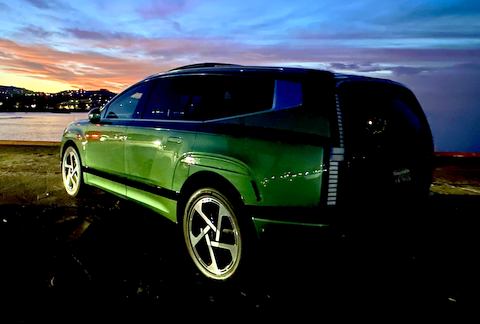
Hyundai placed an emphasis on interior space which means the exterior design needed to be maximized at all four corners. The minimal front and rear overhangs, a long wheelbase and flat floor created spacious passenger room. The panoramic sunroof opens the interior to the outside world.
The gently sloping roof and an abrupt, near vertical rear end give it a boxy look. But the soft edges, flush power door handles and active air flaps in the lower front fascia, an underbody cover and hidden antennas all contribute to a very respectable 0.269 coefficient of drag.
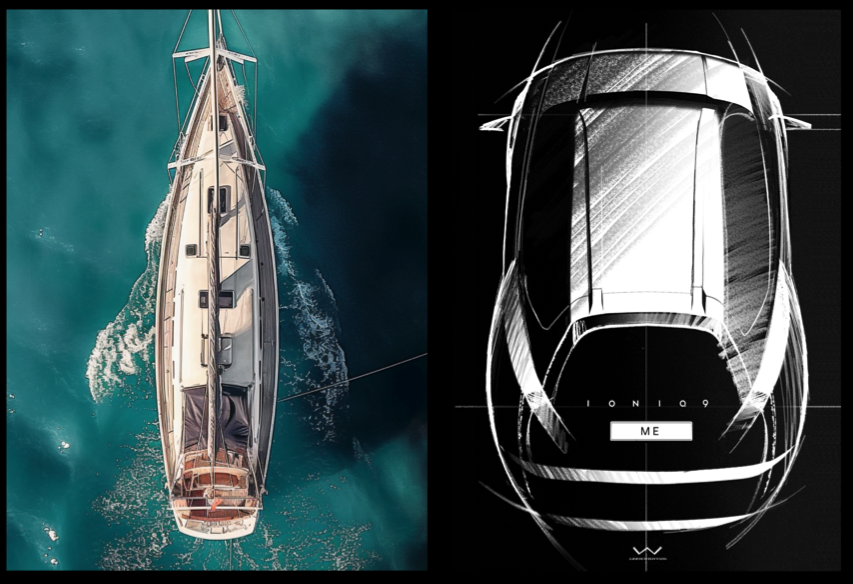
Another design tool to create interior space is, when the Ioniq 9 is viewed from above, the ‘Boat-tail’ design. It has a front fender width narrower than the rears, with the hips being the widest point. The look is similar to a sleek sailboat.
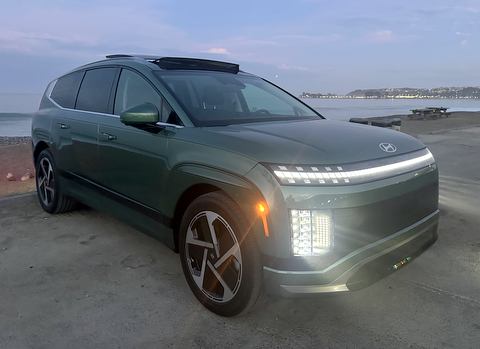
The LED head and tail lights, with a parametric pixel design, have become a Hyundai trademark. There are four aerodynamic alloy wheel designs in sizes—19, 20 and 21 inches.
The Ioniq 9 has nine exterior colors: Abyss Black Pearl, Cyber Gray Metallic, Snow White Pearl, Ecotronic Gray Matte, Gravity Gray Matte, Cosmic Blue Pearl and Sage Silver Matte. The two we drove were in Ultimate Red Metallic and Ionosphere Green Pearl.
Spacious and Premium Interior
The term spacious sometimes is used loosely when describing interior space. What we found was a completely flat floor providing stretch-out leg room, with shoulder and head room for up-to seven occupants. Up front the floating bridge console is moveable and incorporates cup holders and charge ports.
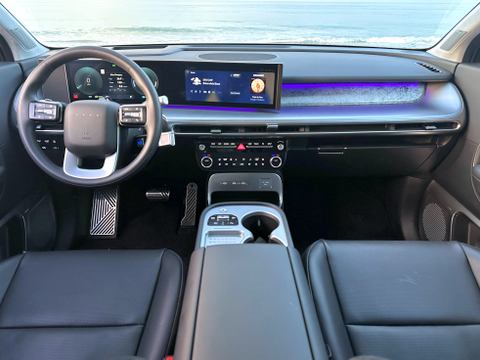
With an eye on sustainability the seats are covered in either bio-based stain-resistant cloth or, like ours, H-Tex synthetic. The heated and ventilated 8-way power driver and passenger seats have power lumbar with the driver getting memory.
The power-ventilated second-row Captain’s Chairs (only available in the Limited and Calligraphy trims) swivel and recline. They are power-operated to slide and fold to accommodate easy access to the third row. Second-row occupants get manual window shades, ventilation controls, USB-C charge ports and power leg extensions. The third-row bench seat power folds to expand the generous cargo capacity. Additional small item storage in the front trunk (frunk) is available.
There are three screens, beginning with the 10-inch configurable head-up display projected on the windshield. The 12.3-inch digital instrument cluster, which is also configurable with an assortment of important vehicle information, is connected to the 12.3-inch horizontal color infotainment screen. Entertainment was through the 14-speaker Bose premium audio system with AM/FM/SiriusXM, wireless Android Auto, Apple CarPlay and Bluetooth for streaming and hands-free telephone. The Bluelink app provides access to vehicle systems including remote start and remote charging, and the Digital Key provides extra convenience and safety.
Additional interior features are front and third-row USB-C media and charge ports, changeable ambient lighting, wireless phone charging, Wi-Fi hot spot, three-zone automatic temperature control with second and third-row vents, power or manual tilt-and-telescoping leather-wrapped steering wheel, cruise control with limited hands-free driving, push button start and stop, automatic dimming rear view mirror with Homelink, power windows and a power remote hands-free rear lift gate.
Safety
The IONIQ 9 comes with an extensive list of standard safety features, beginning with 10 airbags. Hyundai’s safety tech is robust with advanced driver assistance systems (ADAS), including lane keep assist, blind spot detection, forward collision avoidance and rear cross-traffic avoidance assist. Other features are hill start assist, auto hold, a surround and blind view monitor with parking sensors and a tire pressure monitoring system.
Warranty
- New Vehicle – Five years/60,000 miles
- Powertrain – 10 years/100,000 miles
- Electric Vehicle – 10 years/100,000 miles
- Anti-perforation – Seven years/Unlimited miles
- Roadside Assistance – Five years/Unlimited miles
Pricing
The 2026 Hyundai Ioniq 9 is produced at the massive Hyundai Motor Group Metaplant America (HMGMA) in Ellabell, Georgia, near Savannah. It comes in six trim levels. These prices include the $1,600 freight charge.
- S RWD $60,595
- SE AWD $64,365
- SEL AWD $67,920
- Performance Limited AWD $72,850
- Performance Calligraphy AWD $76,590
- Performance Calligraphy Design AWD $78,090
Observations: 2026 Hyundai Ioniq 9
This is an easy one to summarize. If you are in the market for a premium large SUV that seats up to seven in true comfort and style, and are ready to make the move to electrification, then the all-electric 2026 Hyundai Ioniq 9 should be high on your shopping list.
With fast charging and a minimum of 300 all-electric mile driving range, the Ioniq 9 will easily handle all your family in-town errands and make taking a longer road trip very doable, all while eliminating the need to ever stop at a gas station again.
Make sure to opt-in to the Clean Fleet Report newsletter (top right of page) to be notified of all news stories and vehicle reviews.
Story by John Faulkner. Photos by John Faulkner and Hyundai.
