
Volvo has long been known for building safe cars with innovative engineering. Ask pretty much anyone who has owned one, and they will tell you the confidence they get from driving a safe, well-built car was a major reason for their decision to go with Volvo.
This year (2025) is the 70th year Volvo has been selling cars in the United States. Its reputation on safety hasn’t changed, but now extends to offering a wide variety of cars and SUVs, all with distinctive Scandinavian design, even though the company is now part of the Geely Holding Group of Hangzhou, China, after a stint as part of Ford Motor Company.
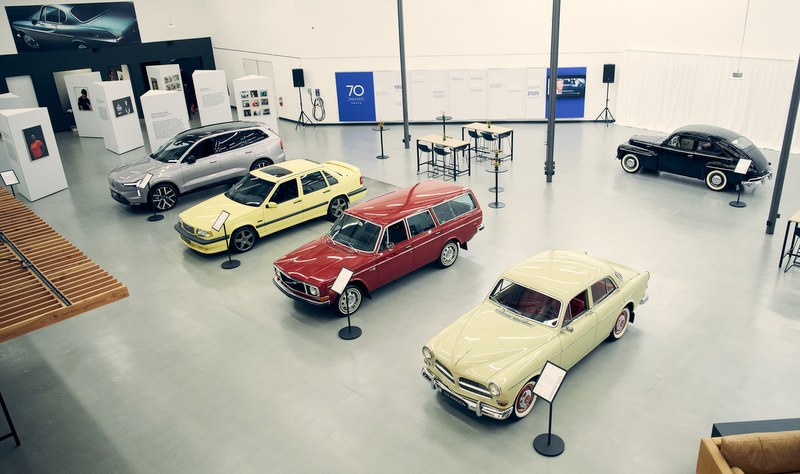
Volvo recently invited automotive journalists to tour its former design space in Camarillo, California, that was specially set-up as a walk-through of Volvo’s U.S. history. On display were pristine Volvo models form the past several decades, including some that could be driven. The star (for me!) of these was the P1800 with its Italian design that hit American shores in 1961. This classic coupe went through name changes of P1800, 1800S and 1800E, but always retained its long hood and fastback roof that gave it a head-turning design, then and now.
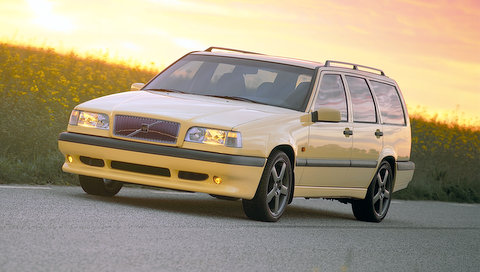
Some of the other historical cars included the first to arrive on American shores of the PV444 Coupe (1955); 122S Amazon Sedan (1956); 145E Wagon (1967); 245 GTL Turbo Wagon (1974); 850 T-5R Wagon (1985); 850 T-5R Sedan (1991); V70 XC Wagon (1997); C70 Coupe Cabriolet (2006); S60 Sedan (2007) and two performance wagons—the V60 Polestar (2010) and the V60 Polestar Engineered (2023).

To get insight into where Volvo has been and where they are going, Clean Fleet Report sat down with Thomas McIntyre Schultz, product and technology communications, Volvo Car USA. If you aren’t familiar with Volvo, this was a fascinating conversation.
Clean Fleet Report: Can you give a quick overview of Volvo selling automobiles in the United States for the past 70 years?
Thomas McIntyre Schultz, Volvo: For the last 70 years I think two things have been true about Volvo which existed simultaneously. One is what has changed over the past 70 years is how we constantly adapt to our customers needs and wants. Whether this be utility or electrification, our brand stands for safety, durability and putting people at the center of everything we do.
What we offer has changed in terms by how it is fueled and the vehicle sizes and shapes, but what you get from Volvo has been very consistent.
CFR: Is the United States your largest single market?
Volvo: I would need to get you the latest data but it is always between Sweden, the United States and China.
CFR: The population of Sweden is about the same as New Jersey (Ed: Where Volvo has its U.S. headquarters), so the United States must be selling more vehicles.
Volvo: Sweden has 10 million people, but one out of every five cars sold there is a Volvo versus the U.S. has 320 million people and one out of every 200 cars sold is a Volvo. So, that is where you get the competitiveness on the market sizes.
CFR: When your designers are looking five years ahead, does the U.S. buyer with our physical body size, driving patterns and lifestyle come into play when designing a new model, and does that bleed over to the rest of the world?
Volvo: I can’t give you specifics, but can say broadly, yes, but that is true for every market around the world. We are a global company that builds global products. An example is the 2026 EX90 that has to suit U.S. customers, European customers, Japanese customers and Chinese customers, so we need to incorporate a balance for everyone’s needs. Of course you will see some differences in what is popular in each market. You will see some a preference for larger cars being popular in the U.S. than in Sweden or Japan, where the roads are much smaller. We look at what people are saying they want and industry trends, but it is always about how people use their cars.

But we do not build specifically for one market or another.
CFR: The Chinese automobile manufacturer Geely acquired Volvo in 2010. How does its involvement affect the company?
Volvo: I want to start with a quote that our CEO (Håkan Samuelsson) gave recently saying: “We are as Swedish as meatballs.” That is a good way to put it. I have been with Volvo for 10 years, and Volvo is Swedish through and through and are publicly listed in Stockholm. Our majority shareholder is Geely, but when it comes to product for what is right for Volvo that is all happening in Sweden. All of our engineering is done in Sweden and our design center is there too. We are an incredibly Swedish company.
Where the collaboration with Geely comes in, remembering we are a very, very small company in the global automotive landscape, is where we can find synergies in purchasing using the leverage of Geely as a much larger automotive group to find savings.

CFR: Let’s talk manufacturing for a global brand.
Volvo: Our long-term ambition we have been working towards for many years now is to build cars where we sell them. This is why we have manufacturing sites in Europe, the U.S., China and, of course, our largest is in Sweden. Every car sold in Europe is built in Europe, either Belgium or Sweden, or the U.S. in Ridgeville, South Carolina. Cars sold in China are built at our Chinese factory. Where cars from those factories are exported is to countries where it makes sense to do so. An example is the EX90 is built in the U.S. and exported to Europe.
CFR: Volvo currently offers models propelled by mild hybrid, hybrid, plug-in hybrid and pure electricity, all in SUVs and one station wagon. Are you set in your product mix, or are there new categories such as a truck, van, station wagon, convertible, sedan or coupe on the drawing board?
Volvo: We are pretty happy with the product mix we have. Areas we pursue are segments that are large, because as a small company we do not have the resources to be developing other products, so we focus on our core products and make them fantastic. We then look for segments that align with our values of protection of people, protecting the planet and making cars that are safe, practical, comfortable and luxurious for families. We build cars for people that value those things, so those are the segments we want to pursue.

CFR: What will the EX30 EV with the single motor do for Volvo?
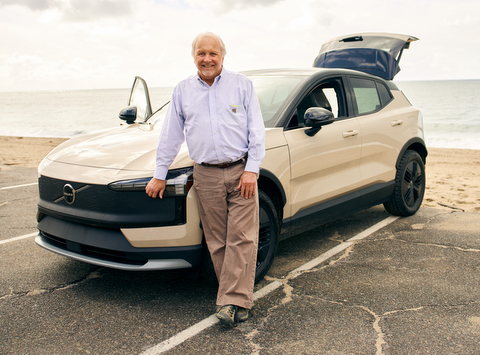
Volvo: The most important thing is it gives people a new entry point to our brand. The EX30 EV Single Motor, in the Plus configuration, is now the most affordable Volvo. For lot of people their first Volvo experience will be in a fully electric SUV. This is where our future is going. This is important for us that a space previously occupied by a gasoline sedan is now a fully electric SUV.
CFR: In closing, when getting up in the morning, what excites you about Volvo?
Volvo: I am really excited about the future of this company. While I cannot speak in detail about future product, I have seen some of it and am excited about what I have seen. The next new model for us is the EX60 coming out on January 21 (2026) as I think it will change a lot of people’s perceptions of Volvo because of what it can do. The EX60 (Ed note: this is a battery electric compact luxury crossover/SUV) will be huge for our brand.
Make sure to opt-in to the Clean Fleet Report newsletter (top right of page) to be notified of all new stories and vehicle reviews.
Story by John Faulkner. Photos by John Faulkner and Volvo.
Clean Fleet Report‘s recent Volvo road tests:
Road Test: 2024 Volvo XC90 Recharge PHEV
Road Test: 2023 Volvo C40 Rechanrge EV
Road Test: 2023 Volvo XC60 Recharge PHEV
