
This article may contain affiliate links.
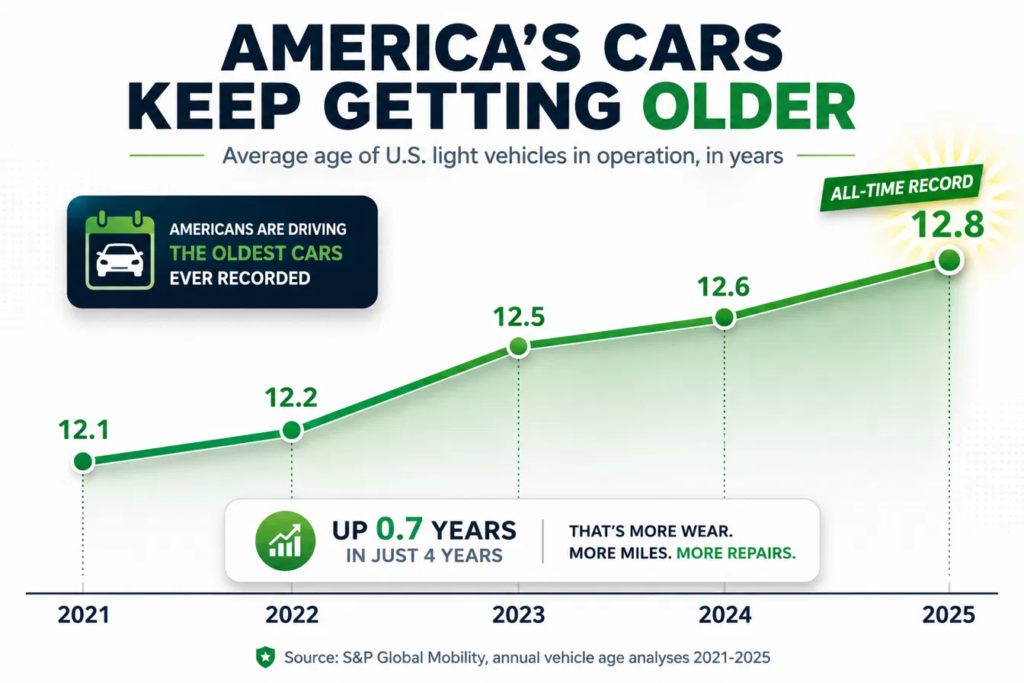
The average car on American roads is now 12.8 years old, an all-time record and the second straight year the number has climbed, according to S&P Global Mobility. That is not a story about drivers falling behind. Increasingly it is a choice: in Synchrony’s 2025 Cost of Car Ownership survey, nearly 60 percent of consumers said they are keeping their existing vehicle rather than buying new. And here is the part that gets missed. For most households, the greenest and cheapest option turn out to be the same one, and it is already parked in the driveway.
Is it Greener To Keep Your Old Car or Buy a New One?
For the majority of drivers, keeping the car you own is the lower-carbon move, because every new vehicle arrives carrying a manufacturing debt it has to pay down. Volvo’s published lifecycle assessment put the production footprint of a gasoline XC40 at roughly 14 metric tons of CO2, and about 24 tons for its all-electric sibling, before either car has covered a single mile. Work by the UK’s Low Carbon Vehicle Partnership points the same direction: around a quarter of a conventional car’s lifetime emissions are generated at the factory; for a battery electric vehicle the share is closer to half.
A car that already exists has already paid that bill. Each additional year of service spreads the factory emissions across more miles, which is why lifecycle researchers keep arriving at the same unglamorous conclusion: the greenest car is usually the one that is already built.
None of this is an argument against electrification. If you rack up serious annual mileage, an efficient EV can work off its production debt within a few years and come out well ahead. The sequence is what matters. Running your current car to the end of its useful life and then going electric beats scrapping a healthy vehicle today, both on carbon and on cash.
How Long Can a Modern Car Actually Last?
Longer than most owners give it credit for. American passenger cars now average 14.5 years in service, per the same S&P Global Mobility analysis, and 200,000 miles is a realistic target for mainstream models that get consistent care. The fleet data shows the whole country quietly proving the point.
The Money Side: What Does Switching Actually Cost?
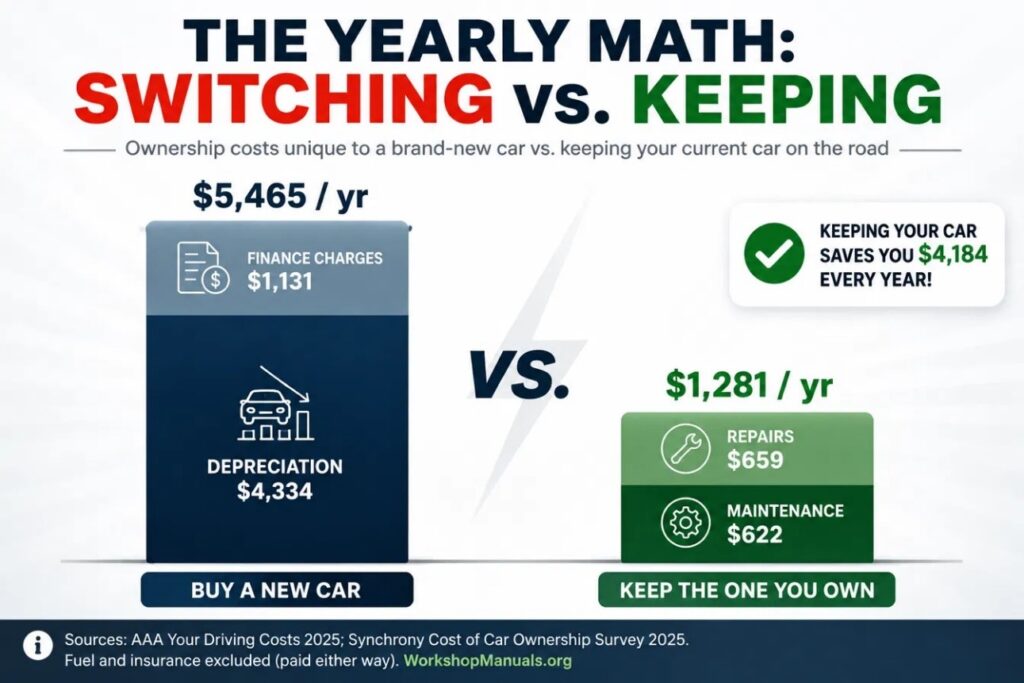
AAA’s 2025 Your Driving Costs study puts the total cost of owning and operating a new vehicle at $11,577 a year, about $965 a month. Two of the biggest line items exist only because the car is new. Depreciation runs $4,334 a year on AAA’s numbers, and finance charges add another $1,131. That is roughly $5,465 a year the owner of a paid-off vehicle simply never spends.
The counterweight is upkeep. Synchrony’s 2025 survey measured average annual spending of $622 on maintenance and $659 on service and repairs, call it $1,281 a year to keep an existing car healthy. Fuel and insurance are excluded from both sides of that comparison for a simple reason: you pay them either way.
Even a rough year with one ugly repair bill usually leaves the keeper thousands of dollars ahead. A $1,500 transmission service stings; $4,334 of silent depreciation stings more, it just never sends an invoice.
What It Takes to Keep a High-Mileage Car Healthy
Reaching 200,000 miles is not luck, and it is not reserved for one or two legendary nameplates. Owners who get there tend to do three things differently.
First, they follow the factory schedule rather than the sticker on the windshield. Transmission fluid, coolant, brake fluid and spark plugs all have real service intervals, by time as well as mileage, and skipping them is where slow, expensive damage starts.
Second, they fix small problems while the problems are still small. A weeping hose costs a clamp and 20 minutes. The same hose, ignored through one hot summer, costs a head gasket.
Third, they work from the factory documentation. Every model was engineered alongside a workshop manual that spells out how the manufacturer intended the car to be serviced: torque specifications, fluid types and capacities, wiring diagrams, service intervals and step-by-step diagnostic procedures. Dealership technicians reference these every working day, and the same factory manuals are available to owners as instant downloads from specialist archives like Workshop Manuals. For a DIY owner, the factory manual turns guesswork into procedure. For everyone else, it makes the conversation at the repair shop sharper: you know what the job involves before anyone quotes it.
Quick Answers for Keepers
Is it cheaper to fix an old car or buy a new one?
Almost always cheaper to fix. With new-vehicle ownership averaging $11,577 a year and typical upkeep on an existing car near $1,281, an older vehicle has to be extraordinarily unlucky before replacement wins on cost alone.
At what point is a car not worth fixing?
A workable rule: when a single repair approaches the car’s market value and more big jobs are visibly queued behind it, or when structural rust enters the picture. Short of that, individual repairs, even four-figure ones, rarely beat the yearly cost of starting over.
Can you still do your own maintenance on a modern car?
Yes. Modern cars carry more electronics, but oil, filters, brakes, coolant, plugs and suspension work remain fundamentally the same jobs they have always been. The difference between a frustrating afternoon and a clean one is usually information: the factory manual for your exact year and model gives you the correct sequence, specs and warnings instead of a forum guess.
The next time the new-model ads start working on you, run the two numbers that matter: what your current car needs this year, and what a replacement quietly costs every year. For most drivers the verdict is the same on both the climate ledger and the bank statement. Drive the one you have well, and make the switch when it genuinely earns its keep.
