
This article may contain affiliate links.
There are many things a coated floor will withstand if driven or walked on every day. However, it would still be prudent to take some steps to preserve its condition. Dirt will be tracked on the bottom of tires; there may be slow leaks from vehicles; melted snow will evaporate leaving a layer of grime, to be abraded in on subsequent visits.
Fortunately, there is no need for elaborate equipment to keep most coatings clean and in good order. All that is required is a sensible regimen and appropriate materials, and to be alert to deterioration in appearance.
Topics Covered
- Establish requirements of existing coating
- Routine cleaning
- Additional measures required with de-icing salt
- Approaches to various types of spillages
- Minimizing mechanical damage
- Types of damage suitable to refer to an expert
- Summary
Establish Requirements of Existing Coating
It is worthwhile establishing the nature of any current coating, prior to selecting materials to wash with. Requirements may well differ, for example, between an epoxy, a polyaspartic and a simple paint.
Ideally, this information should be available from the installer, along with suggested washing regimes, minimum cure periods and the requirements to maintain any warranty. Failing this, it is better to inquire about them.
Failing all that, try to obtain from any available records at least an overall designation of the coating system. As noted above, various finishes may require different washing products, and what may be harmless to one may be aggressive towards another.
For example, several coats may be applied, as with the range offered for garage floor coatings. In the linked system, a polyaspartic topcoat is applied over a polyurea base. As all driving, sweeping, washing, etc., would impinge upon this uppermost layer, it would be appropriate to use washes suitable for it.
Depending on the product, there will generally be a minimum period prior to driving, washing, installing matting and so on. Even if the floor looks dry, follow the specified cure periods before driving, washing, or laying mats.
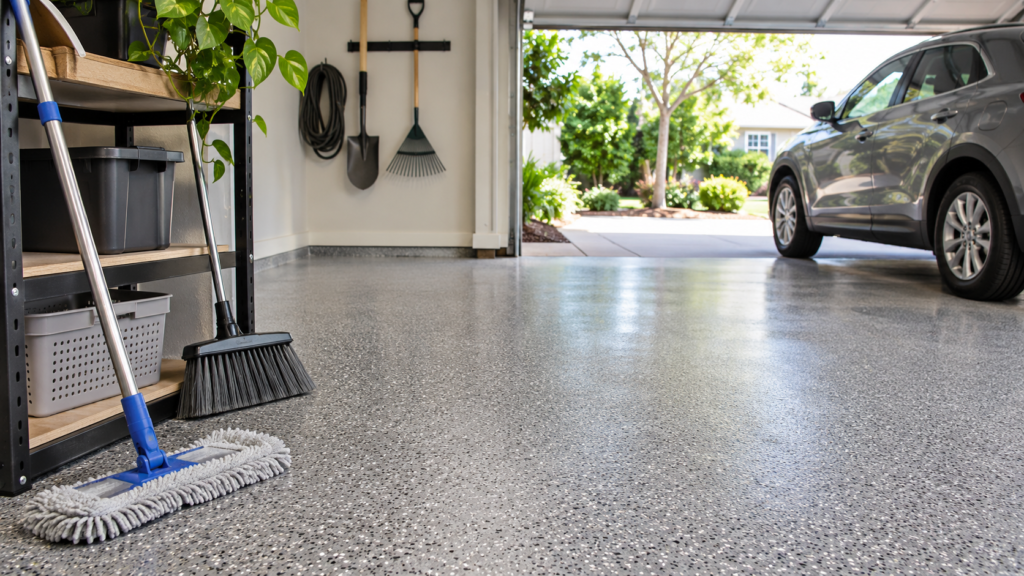
Routine Cleaning
Fine abrasives will gradually be tracked over large areas by footwear and vehicle tires, dulling much of the surface area, although without necessarily impairing adhesion of the coating.
Frequency of washing will depend on usage. As a minimum for most applications, sweeping once a week with washing as required, seems reasonable. More frequent attention may be desirable for very heavy usage, for example, a workshop.
- Sweep up any significant loose debris, being careful not to drag it over the surface, with a reasonably soft broom, dust-mop or similar, or with a vacuum.
- Pay particular attention to perimeters and areas under parked vehicles.
- Apply water and a gentle detergent, suitable for the relevant coating, to soiled areas only. If unsure of suitability, try on a discreet area first.
- Rinse and remove surplus liquid with mop, wet vac, squeegee or similar tool.
More effort may be required to clean recesses in a flaked or other rough texture to remove accumulated soiling. Excessive scrubbing should be avoided; ideally only to remove soiling, without abrading the surface, and with as little residue as possible.
Additional Measures Required with De-Icing Salt
A significant amount of salt, slush, etc., will be tracked in on vehicles during much of the winter in many areas of the country. It may be difficult to appreciate the quantity of salt applied to roads, but this was estimated to be around 37% of total U.S. salt consumption in 2025 (USGS, 2026). There is no direct correlation to the extent of soiling of garages, but this at least indicates the likely widespread occurrence.
It is undesirable for this to be allowed to dry on in successive applications. It is sensible to sweep up loose material, squeegee up free water, and periodically rinse off deposits, avoiding leaving pools against walls, expansion joints and so on.
Also check around edges and any existing defects to ensure water run-off does not penetrate to the concrete. The ACI cites freezing and chemical attack by some salts on water-logged concrete as possible causes of joint deterioration.
At the end of the winter it would be prudent to give a general wash and pay particular attention to the door area and areas under parked vehicles. Obvious care should be taken to prevent slipping, particularly to provide a safe route out of the garage and around any normally dry areas.
Approaches to Various Types of Spillages
Many different substances may be spilled, and will react variously to the surface. Prolonged contact will often stain, and may leave an area slippery.
It is best to remove as much as possible as soon as practicable, and then wash off using an appropriate product. Observe any precautions recommended on containers of spilled materials, particularly motor vehicle related.
It would be unwise to apply the most aggressive agent available, for example, strong solvents, acids, scouring powders or pads, as these may all be detrimental to some surfaces. Obviously, no combination of chemicals.
Persistence would best be treated with progressive measures: a mild detergent; allowing to stand; light brushing; and washing off and assessing.
Thereafter it would be prudent to seek advice from the installers or suppliers, rather than applying stronger solvents, which could result in more obvious disfigurement.
Minimizing Mechanical Damage
In addition to general cleaning, obvious precautions can reduce damage. Tool-chests or other items are commonly slid over the surface, stands and other heavy objects lowered on to it, objects dropped and so on, all of which may scratch or chip it.
It is preferable to lift items when relocating them, use protective feet under storage units, etc.; refrain from ‘burning’ tires with the car stationary, and ensure any protective mats, etc., are suitable and do not retain water on the coating.
It would be sensible, when undertaking a monthly visual inspection, to look in particular for damage exposing other layers, further lifting of edges, blisters, discoloration, areas of persistent loss of sheen, pooling of water and so on. Any changes should preferably be recorded photographically, to indicate progression, and to be available to any repairers.
Types of Damage Suitable to Refer to an Expert
Of course, some apparent imperfections may prove trivial. For example soiling in a rough texture or general dulling may respond to washing. However, any lifting, cracks, blistering, delamination and similar may all be associated with inadequate adhesion, water penetration, substrate defects and so on, and may well be masked if simply over-coated.
The installers would be in the best position to advise on the feasibility and method of making goods locally, or re-applying a top coat. This would depend on many considerations, including the nature of existing coating and substrate and feasibility of adequate preparation. It should not be taken for granted that a further application would adhere satisfactorily to all existing coatings.
It would be helpful to collate information on the original date of application, washing regimes and products used, photographs, subsequent repairs and so on, to be available in any discussions regarding guarantees and future attention.
Summary
With regular attention to sweeping and removal of soiling, cleaning up spills, winter soiling and periodic inspection of areas likely to be subject to abrasion, using appropriate products for the particular surface, life and appearance of a coated floor can be better protected. Clearly, this is preferable to attempting to remedy more advanced neglect!
