
This article may contain affiliate links.
Mastering EV garage clutter requires zoning your daily charging equipment, utilizing overhead space for seasonal gear and keeping sensitive electrical accessories separated from traditional shop tools.
Electric and hybrid ownership introduces new categories of home gear like bulky Level 2 cables, portable connectors and specialized tire inflators that quickly consume floor space. Applying these four organizational principles transforms a frustrating obstacle course into a functional, hazard-free home charging setup.
You made the switch to electric or hybrid driving, enjoying cleaner fuel, a quieter ride and lower emissions on every commute. Then you got home, pulled into the garage and discovered the reality of managing the extra equipment that comes with clean transportation. There is often a cable coiled on the floor, and a tire inflator sitting next to summer roof rack parts. Facing such cramped spaces, many homeowners restore their parking footprint by moving seasonal items off the floor.
Utilizing tools like Inventive Garage’s attic lift allows you to clear out bulky overflow like roof racks and winter tires, leaving the ground floor dedicated entirely to your daily charging needs.
That clutter is not a character flaw, as EV and hybrid ownership genuinely introduces a new category of home gear that traditional garage organization advice rarely accounts for. The good news is that the fix is incredibly straightforward. These four practical tricks will help you build a garage that actually works around how you drive and charge daily.
1. Zone Your Charging Equipment Like It Has a Permanent Address
Most EV owners end up with at least two charging solutions at home, including a hardwired wall connector and a portable mobile connector for travel.
That means managing two cables, a handful of adapters, and a travel bag that all need somewhere to live. Without a defined home, they end up wherever there is empty floor space. That is exactly where trip hazards start, especially since most residential Level 2 chargers operate at up to 30 Amps, delivering 7.2 kW of power safely but add physical bulk.
Level 2 cables are about ¾ inches in diameter with a typical length of 18 feet to 20 feet (allowable up to 25 feet), meaning a loose cable becomes a daily obstacle. Beyond the safety issue, cables left coiled on concrete are more susceptible to jacket wear in extreme temperatures.
The fix is simple, designate a charging station zone near your vehicle’s charge port side and strictly maintain it. A dedicated shelf or small cabinet beside the charger gives the portable mobile connector a permanent address. Hybrid owners accumulate similar clutter, meaning plug-in cables, portable inverters, and 12V accessories all benefit from the same zoning discipline.
| Pro Tip: Wall-mounted cable hooks prevent “cord memory” and jacket wear. Keeping Level 2 cables off the floor eliminates tripping hazards and protects the internal wiring from temperature-related degradation caused by cold concrete. |
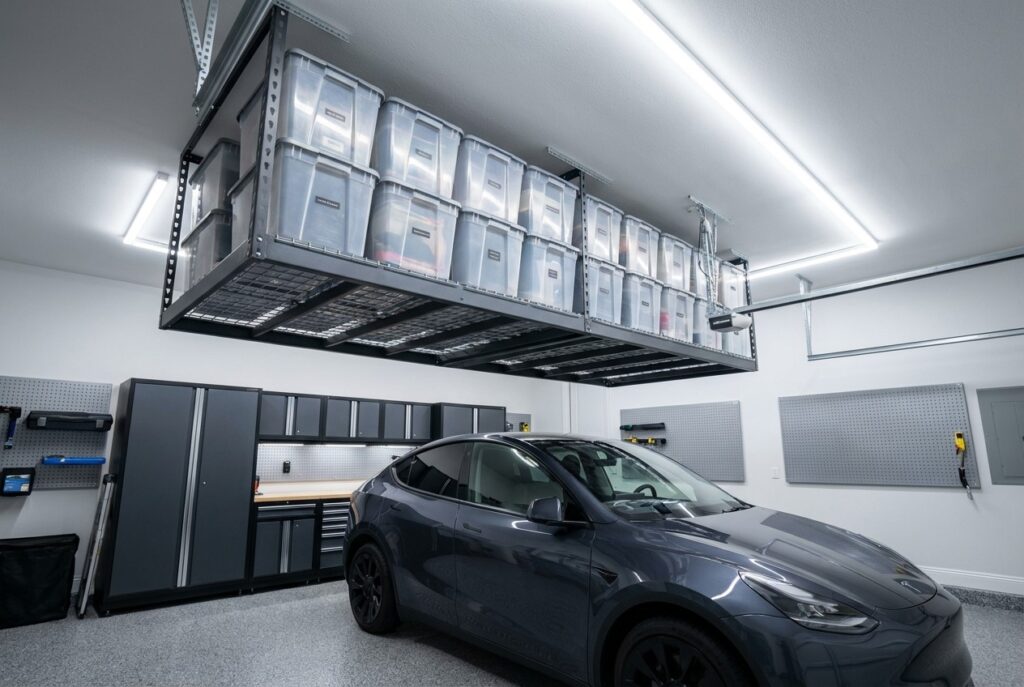
2. Send Seasonal and Rarely Used Gear Overhead
Not everything EV ownership brings into your garage needs to live at eye level. There is a large category of gear that matters when you need it, but spends most of the year doing nothing except eating up floor space.
When the vehicle zone genuinely competes with workshop storage and household overflow, moving the bulkiest items out of the main area becomes necessary. That list of seasonal equipment usually includes cold-weather extension cables, winter charging gear, roof rack crossbars, camping accessories and spare charge adapters.
Overhead space is the most underutilized real estate in most residential garages. A heavy-duty overhead rack or ceiling-mounted platform can hold labeled seasonal bins without encroaching on your parking area.
Standard ceiling height in attached garages runs 8 to 10 feet, leaving meaningful clearance above the vehicle roofline for dedicated storage. Knowing the minimum interior dimension of garages shall be 10 feet wide and 20 feet deep dictates utilizing vertical height rather than crowding the perimeter.
Grouping items into clearly labeled bins means you are never digging through a pile of automotive supplies just to find one specific travel adapter.
3. Keep Electrical Accessories Away From the Wrong Neighbors
This principle rarely appears in standard organization guides, but it is highly relevant for EV and hybrid owner tips regarding charging cables and high-voltage adapters.
Electrical accessories should never share unorganized shelf space with metal hand tools, loose fasteners or open containers of automotive fluids. This is about practical zoning that prevents accidental damage and ensures safety.
Charging cable jackets can be abraded by contact with sharp tools, and connector pins can be bent or contaminated by metal debris. Portable power stations and lithium-based inflators are sensitive to both heat and corrosive materials. Storing them near open cans of solvent is risky and could compromise the equipment.
The practical solution is to label your storage and separate items by distinct functional categories. Create a designated drawer strictly for charging cables and a separate section for 12V accessories. Keep conventional tools in their own zone, completely away from electrical gear, so you can safely grab a portable inflator in seconds during an emergency.
| Warning/Important: Avoid storing sensitive electrical connectors near loose metal shavings or corrosive fluids. Sharp tools can puncture cable jackets, while chemical vapors may degrade the plastic housing, potentially causing dangerous short circuits during charging. |
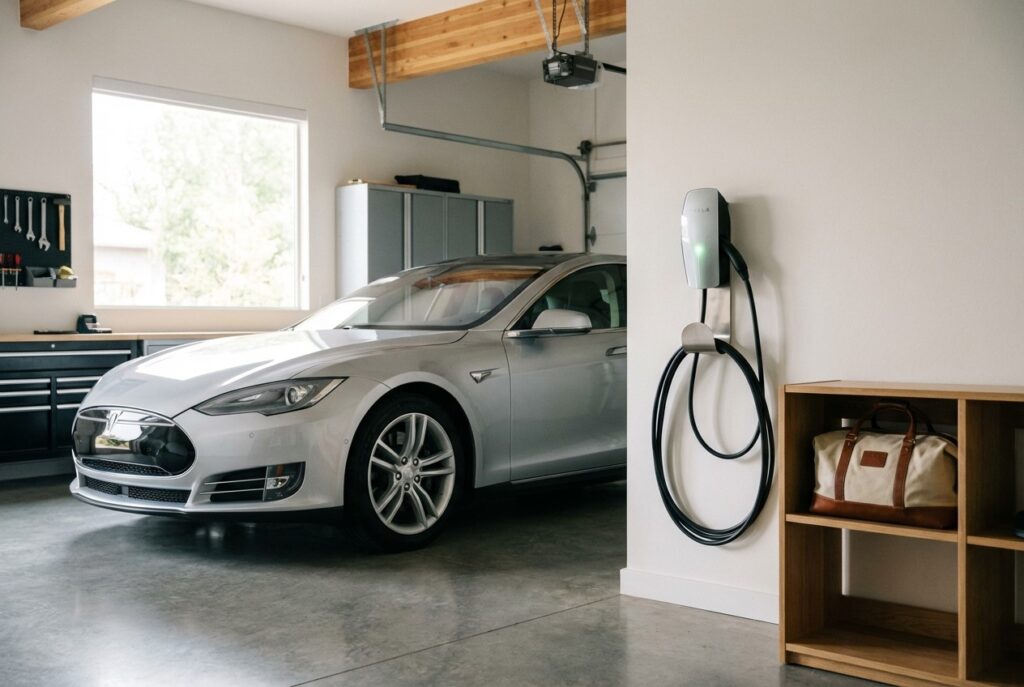
4. Design the Layout Around How You Actually Use the Space Daily
The best garage storage for electric car owners works with your daily driving routine, not against it. Walk through the space as a workflow by visualizing how you pull in, step out, grab the charging cable and plug in.
That sequence should happen flawlessly without navigating around a single obstacle on the floor. The charging station should sit on the same side of the garage as your car’s designated charge port. The path from your driver’s door to the house entry must be completely clear, even in the dark when carrying groceries.
Frequently touched items belong within arm’s reach of the vehicle, while infrequent gear moves to the back or goes overhead.
Lighting ties the entire setup together beautifully. High-lumen LED strips above the vehicle zone make plugging in easier after dark and help you spot loose items before stepping on them.
Proper lighting also makes routine EV maintenance, like checking tire pressure or cleaning camera sensors, much easier to accomplish.
The Bottom Line
EV and hybrid ownership completely changes what a functional home garage needs to accomplish. The gear is different, the daily habits are different, and standard organization methods do not always keep up with these new demands.
However, the framework is incredibly simple, requiring you to zone your chargers, move seasonal gear overhead, keep electrical accessories separated and design your layout efficiently.
A garage built around those four principles reduces friction every single time you pull in. You always know where your emergency roadside kit is located, and winter charging gear stays accessible but out of the way.
That is the real payoff of proper EV garage organization, yielding a daily routine that is measurably easier and less stressful.
