
This article may contain affiliate links.
The four most effective tablet tricks for effortless service fleets include implementing digital vehicle inspections, providing real-time dispatch visibility, enabling on-site payment collection and transitioning to paperless service documentation to improve overall service fleet efficiency.
Modern fleets run on more than just fuel or battery charge, as they rely heavily on seamless communication and accurate data. Upgrading in-cab and field-ready tech closes the gap between drivers and dispatchers, reducing paperwork and creating cleaner operational handoffs.
This challenge is especially familiar to operators managing mixed fleets of EVs and conventional vehicles. When operational complexity is already high, tracking charge levels alongside fuel consumption and routing by range constraints creates friction.
A missed dispatch update or a stack of unprocessed paper inspection forms does not just slow one driver down. It creates friction that ripples across the entire fleet.
The good news is that tablets are among the most accessible fleet technology upgrades available for closing that gap. Properly deployed and securely mounted, these devices transform in-cab and field workflows in ways that simultaneously improve productivity, customer experience and back-office operations.
Whether utilizing fixed cab brackets for navigation or a mobile stand for customer interactions, standardizing this tech pays off. Here are four practical ways to put that technology to work.
1. Replace Paper Checklists with Digital Inspections
Pre-trip and post-trip vehicle inspections are regulatory requirements for commercial fleets, and skipping them carries real liability. However, the traditional paper-based inspection process creates its own operational problems. Illegible handwriting, lost forms, and hours spent re-entering field data heavily burden management systems.
Tablet-based inspection tools change that equation entirely. Drivers tap through standardized checklists, add photos where relevant, flag issues in real time, and submit completed reports before leaving the parking lot.
That data flows directly to fleet managers, creating a clean, searchable record without any transcription lag. Industry estimates suggest that paperless fleet operations like digital inspection workflows can reduce reporting-related administrative time by 15 to 20%, a meaningful number across a fleet of 50 vehicles.
For a 25-vehicle utility maintenance fleet, this kind of shift can be transformative. When paper sheets get replaced with tablet reporting, end-of-day administrative work shrinks and data re-entry errors become rare rather than routine.
Digital inspections can include fields for battery health flags, current charge levels and range readouts alongside traditional mechanical checks. Standardizing these workflows on tablets builds the necessary data infrastructure for the mixed fleet of the future.
| Key Insight: Digital inspections slash administrative time by up to 20% while capturing vital data that paper forms miss, such as battery health and real-time range readouts, creating a more reliable record for modern mixed fleets. |
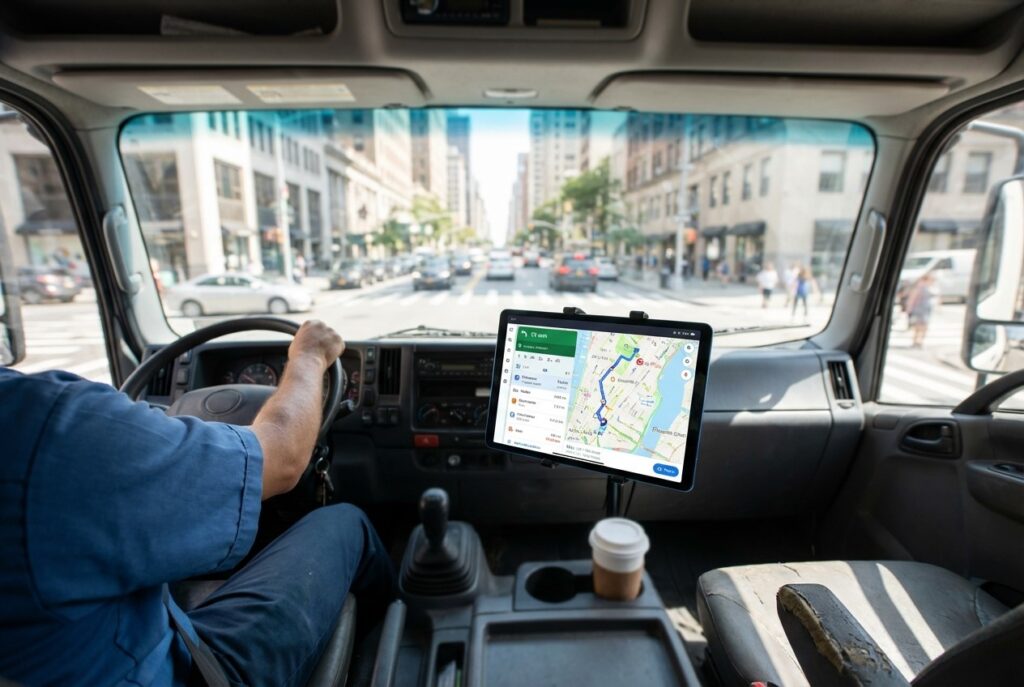
2. Give Drivers Real-Time Route and Dispatch Visibility
Printed route sheets become outdated the moment something changes in the field. In service fleet environments, job cancellations, emergency calls and traffic delays are simply the norm. Without real-time updates, something always changes and causes disruption. The gap between what dispatch knows and what the driver knows is where efficiency quietly erodes.
A technician showing up to a rescheduled job represents the steady accumulation of small inefficiencies. Tablets bridge that gap far better than radio calls or phone check-ins. With a shared dispatch platform running on a mounted tablet, drivers see live job queues and route updates as they happen.
This ensures two-way communication between the field and the office becomes faster and easier to document. Missed or late appointments drop because drivers always have the current information on screen.
For mixed fleets, route optimization platforms that account for EV range constraints alongside gas capacity are far easier to manage through a centralized, tablet-based system.
3. Collect Payments and Complete Service Check-Ins on the Spot
Waiting to invoice back at the office is a cash flow problem disguised as a standard procedure. When payment collection happens hours after the job is done, customer relationships cool rapidly. Disputes become harder to resolve, and accounting data falls behind.
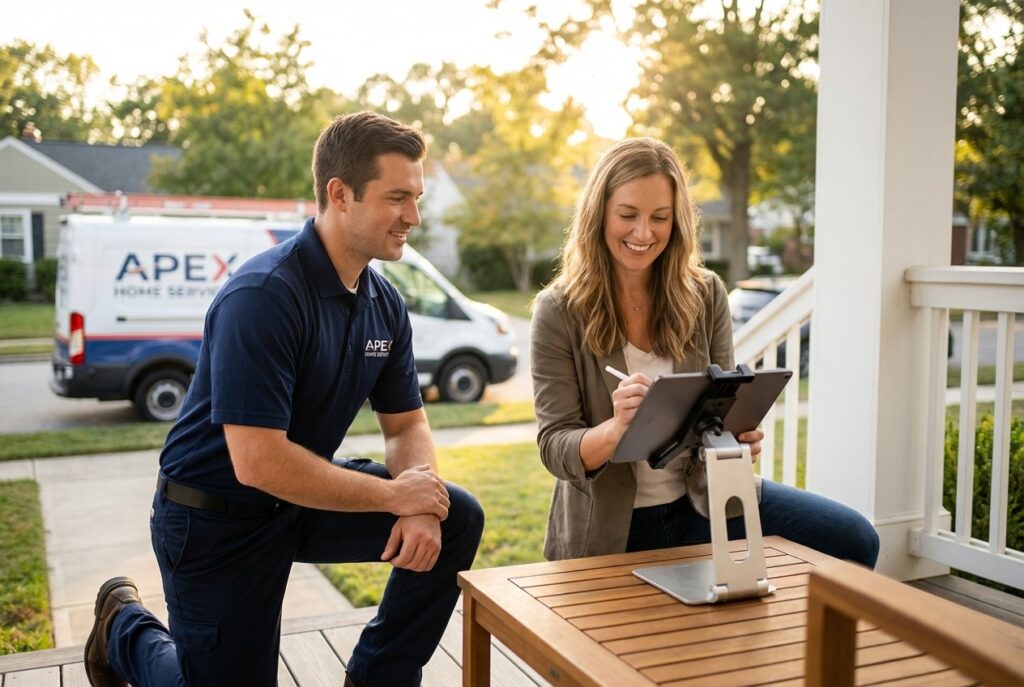
Mobile invoicing apps allow technicians to generate itemized invoices at the job site, accept card payments, capture customer signatures and send email receipts before loading up the van.
Consider a plumbing repair company that equips its service vans with tablets. At the end of every job, the technician pulls up the invoice, walks the customer through the line items, collects payment on the spot and emails a receipt. The job closes immediately, seamlessly syncing with back-office accounting systems.
For that workflow to function reliably, the hardware must be presentation-ready. A tablet balanced on a clipboard is a professional liability. Integrating commercial mounting solutions, such as heavy-duty field cases, ruggedized dash brackets or a POS tablet stand from the experts at VidaBox, transforms a standard consumer tablet into a secure tool.
The downstream benefits include faster payment cycles, cleaner accounting handoffs and a better customer experience.
| Pro Tip: Enhance your professional image by using ruggedized mounts and POS stands for on-site payments. A secured tablet is more reliable than a loose device and signals to customers that your service operation is modern, secure, and highly efficient. |
4. Go Paperless on All Service Documentation
Invoices and inspections get most of the attention, but the documentation burden in a service fleet runs deeper. Work orders, parts logs, warranty records, job notes and proof-of-delivery confirmations all generate paper. This creates friction at every stage of the job lifecycle.
When service records are logged manually, the lag between field and office is constant. Forms get lost, handwriting is misread, and end-of-week filing consumes valuable time. Tablet-based documentation eliminates that lag completely. When technicians log job notes and parts used directly into an app during the job, records sync to back-office systems in real time.
A delivery fleet that digitized its proof-of-delivery process demonstrates this impact. Drivers used tablets to capture geo-tagged photos and customer signatures at the point of delivery, creating an instant, timestamped record for every job. When disputes arose, resolution was fast because the documentation was complete and immediately accessible.
For fleets investing in EVs, paperless operations offer a coherent sustainability statement that reinforces the operational values driving their electric transitions.
The Bottom Line
Fleet managers focused on EV transitions and fuel efficiency are prioritizing the right areas. However, true operational efficiency depends heavily on the entire driver workspace.
Digital inspections reduce compliance gaps, while live dispatch visibility closes the communication distance. On-site payment collection accelerates job cycles, and paperless documentation creates cleaner records.
None of these upgrades requires massive capital investments. Most begin with hardware already in use, combined with field-ready apps and reliable tablet mounts for fleets to deploy them properly. The practical challenge is finding the time to audit current workflows and identify the friction points. Shadowing a driver for a single shift to count manual data entries will quickly highlight which tablet-based upgrade to prioritize.
As mixed fleets grow more complex, the operations that invest in their drivers’ technology will be the ones that pull ahead.
Getting the powertrain right matters deeply for long-term sustainability goals. However, optimizing what happens after the engine starts ensures the fleet performs efficiently at every level.
