
This article may contain affiliate links.
Fleet electrification is past the pilot stage. Logistics operators, last-mile delivery companies and corporate fleet managers are committing serious capital to EV transitions, yet the promised cost savings often fail to materialize. The gap between expectation and reality almost always traces back to software.
Why ROI Is the Real KPI for Commercial EV fleets
Return on investment (ROI) from commercial EV fleets is engineered through intelligent orchestration of routes, energy and charging assets. Until that orchestration is in place, electrification adds complexity without delivering the financial returns that justified the transition.
Where Custom Software Development for Emobility Fits
That orchestration requires purpose-built software. Custom software development for emobility connects the systems that fleet operations depend on and applies fleet-specific logic to turn data into cost reductions and new revenue.
Where ROI Is Created (or Destroyed) in Commercial EV Fleets
Most fleet directors have a clear view of upfront costs when planning electrification. What tends to catch operators off guard is the operational cost structure that follows deployment and compounds quietly over time.
CapEx, OpEx, and Hidden Costs of Going Electric
Fleet electrification requires significant capital expenditure (CapEx), meaning one-time costs covering vehicles, chargers and grid connection upgrades. Running the fleet then generates ongoing operational expenditure (OpEx). Together, these form EV fleet total cost of ownership (TCO), the complete financial picture across a vehicle’s full lifecycle.
Several TCO factors rarely appear on the initial procurement spreadsheet:
- Energy costs spiking when fleets charge unmanaged during peak tariff periods
- Demand charges, fees levied by utilities based on peak power draw within a billing period, triggered by simultaneous charging across depot assets
- Charger downtime disrupting driver shifts and service level agreements (SLAs)
- Vehicle underutilization when charging windows do not align with duty cycles
- Grid upgrade costs from peak load that was never modelled against tariff structures
For fleet directors managing 50 or more vehicles, unmanaged charging alone can add tens of thousands in annual energy overspend.
Top Failure Modes That Erode ROI
As a fleet operations leader, you will likely recognize at least one of these patterns in your current or planned EV estate:
- Charging scheduled by drivers rather than software, creating uncontrolled peak demand
- Route planning and charging planning running in separate systems with no data exchange
- No charger health visibility until a vehicle arrives at a non-functional unit mid-shift
- Energy invoices that cannot be reconciled against individual vehicles or cost centers
- Depot capacity reserved exclusively for internal use, leaving potential revenue uncaptured
These are data and orchestration problems, and they are solvable.
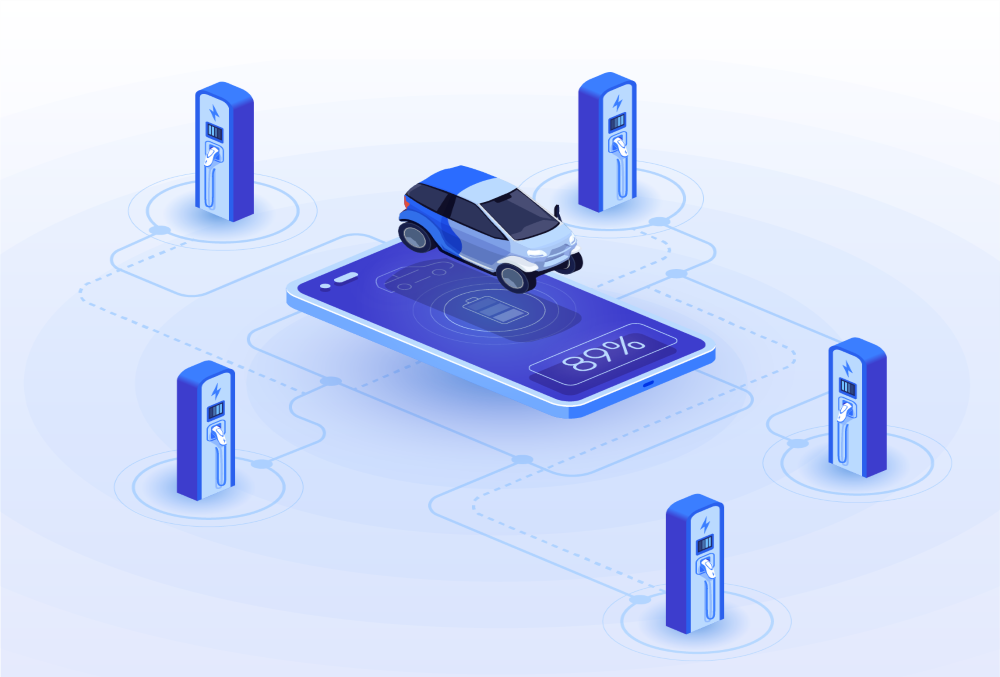
5 Levers to Get +20% ROI with Custom Software Development for Emobility
Each lever below targets a specific cost or revenue gap in commercial fleet operations. Applied together, they compound into a TCO improvement that materially changes the financial case for electrification.
Lever 1 – Optimizing Route Planning and Charging Together
The largest source of hidden cost in commercial EV fleets is the disconnect between route planning and charging planning. When these systems do not share data, drivers detour to direct current fast chargers (DCFC), which are high-power public chargers that replenish batteries quickly, but at a significant cost premium over depot alternating current (AC) charging.
EV fleet route and charging optimization closes this gap through:
- Calculating the optimal state of charge (SoC), the percentage of battery capacity currently available, at departure, based on route distance and payload
- Identifying the cheapest and most reliable charging option for each trip using real-time pricing and availability data
- Adjusting charging schedules automatically when routes or vehicle assignments change
Historical fleet data plays a key role. Patterns in vehicle arrival times and energy consumption per route feed the optimization engine, making decisions more accurate over time. This integration consistently reduces unnecessary fast-charging events, cutting per-kilometer energy cost for logistics and last-mile operations leaders.
Lever 2 – Cutting Energy Costs with Smart, Tariff-Aware Charging
Demand charge management for EV depots generates some of the most measurable returns available to fleet operators. Demand charges can represent 30-50% of a depot’s electricity bill, because a single 15-minute window of simultaneous charging can set the demand peak for the entire billing month.
Depot charging management software applies dynamic pricing logic, meaning automated charging adjustments based on real-time and forecast energy price signals, to shift load in ways that reduce cost:
- Charging vehicles during low-tariff overnight windows and time-of-use (ToU) valleys, where ToU refers to electricity tariff structures that vary price by hour or period
- Capping simultaneous charging to stay within demand charge thresholds set in the energy contract
- Automating “charge when cheap, avoid when expensive” decisions without requiring driver or manager input
- Prioritizing vehicles with the earliest departures while deferring those with longer dwell windows
For a C-level leader evaluating the financial case for depot electrification, tariff-aware charging across 30 vehicles at two depots regularly delivers five-figure annual savings with no change to driver behavior required.
Lever 3 – Increasing Vehicle and Charger Utilization
Underutilization is a quiet ROI drain. A charger idle for six hours every morning represents deployed capital that is not working. As an operations leader responsible for asset efficiency, software visibility is where returns show up fastest.
Custom software development for emobility addresses utilization gaps through:
- Shift and charging window alignment. Matching plug-in schedules to actual duty cycles so vehicles are ready when needed rather than when convenient.
- Asset sharing dashboards. Identifying vehicles and chargers that can be shared between business units without operational conflicts.
- Utilization reporting. Surfacing underused vehicles and chargers with specific rebalancing suggestions to guide capital redeployment.
Lever 4 – Reducing Downtime Through Monitoring and Predictive Maintenance
Every hour a vehicle sits unavailable due to a charger fault carries real cost: missed deliveries, replacement driver overtime, and SLA penalties that accumulate across a customer base. Owners and operators of commercial EV fleets consistently identify unplanned downtime as one of the hardest costs to forecast in their transition business cases.
An EV fleet energy management platform built for commercial operations addresses this through:
- Live charger status monitoring with automated alerts on faults or degraded output
- Vehicle battery health trending that flags degradation before it affects operational range
- Automated escalation workflows that notify maintenance teams and trigger supplier tickets without dispatcher involvement
- Predictive maintenance models, which are algorithms trained on historical fault data to anticipate failures before they cause disruption
Fleets that instrument their assets early accumulate the data needed to shift from reactive to predictive maintenance within 12 to 18 months of deployment.
Lever 5 – Monetizing Excess Capacity and Partnerships
Most commercial depots have charging infrastructure sitting idle outside operational hours. For your EV business, that idle capacity is an asset that software can convert into revenue through controlled third-party access, CPO partnerships or flexibility services sold back to the grid.
Effective monetization of depot capacity requires software to handle several interconnected functions:
- Access control. Authenticating external drivers via RFID or mobile apps using Open Charge Point Protocol (OCPP), the industry-standard communication protocol between chargers and management software.
- Dynamic pricing for fleet EV charging. Setting session tariffs for external users based on time of day and available depot capacity.
- Billing and settlement. Generating accurate invoices for third-party sessions and managing revenue-sharing arrangements with Charge Point Operator (CPO) partners.
A depot with 20 chargers running at 40% utilization during off-peak hours can generate meaningful ancillary revenue while keeping internal fleet scheduling fully unaffected.
What Custom Software Development for Emobility Does for Fleets
The ROI gains described above do not come from individual tools working in isolation. They come from connecting data that currently sits in separate systems and applying fleet-specific logic across all of it.
Unifying Telematics, Charging, and Energy Data
Telematics platforms, which are the GPS and vehicle diagnostics systems tracking location and performance, hold one data set. Charge point management systems (CPMS) hold session and energy data. Energy management platforms hold tariff and cost data. Many energy retailers and fleet telematics providers find that no off-the-shelf product connects all three layers with the operational logic a specific fleet requires.
Custom software development for emobility builds the integration layer that creates a single source of truth for vehicle availability, energy cost per route, and TCO per asset.
Building Fleet-Specific Logic on Top of Standard Platforms
Standard OCPP-compliant CPMS and telematics platforms provide a solid technical foundation. What they cannot provide is the business logic specific to your operation, covering your tariff structures, shift patterns and energy procurement contracts.
As a product or technology leader at a fleet management platform, this distinction is significant. Custom development layers your operational logic onto standard infrastructure so the platform optimizes for your actual business model rather than a generic template.
Monetization Paths Enabled by Custom Software Development for Emobility
Cost reduction is the first financial return from fleet software. The second is revenue generation, and it becomes accessible once the foundational data infrastructure is in place.
TCO-Optimized Fleet Operations
Smart charging strategies for fleets, when implemented through purpose-built software, generate TCO data granular enough to improve decisions at every level of the business:
- Cost per mile by vehicle, route or customer contract
- Energy spent by depot or tariff period, useful for procurement negotiation
- Charger ROI by individual asset, comparing utilization revenue against CapEx and maintenance cost
ROI dashboards built on this data give strategy leaders the evidence base to inform procurement decisions and plan site rollout with confidence. Rather than relying on industry benchmarks, decisions reflect the actual performance of your fleet and support stronger contract design at renewal.
New Revenue Streams Around Energy and Charging
The second monetization path opens depot infrastructure to commercial energy opportunities that standard fleet operations cannot access:
- Fleet depots as public or semi-public charging hubs. Opening capacity to logistics partners or local EV drivers during off-peak hours under managed access control.
- Energy partner programs. Contracting with utilities or Energy Service Companies (ESCOs), specialist firms that design and deliver energy efficiency solutions to commercial customers, to provide demand response using aggregated fleet battery capacity.
- Flexibility services. Using parked EV batteries to respond to grid balancing signals and earn payments from Distribution System Operators (DSOs), the regional grid operators are responsible for managing local electricity networks.
Custom emobility platforms automate the contracting, billing and revenue-sharing workflows that make these models operationally viable. That automation removes the manual overhead that makes energy partnerships difficult to scale at smaller fleet sizes.
Conclusion
A +20% ROI improvement is achievable for commercial EV fleets when route planning, energy management, charging orchestration and asset monetization operate as a connected system. The five levers covered here each contribute independently, and their effects compound when implemented together. Custom software development for emobility turns raw fleet and energy data into decisions that protect margin and reduce exposure to energy price volatility as your fleet scales.
