
This article may contain affiliate links.
An EV can be declared a total loss after a collision even when the decision is driven by repair economics rather than the condition of every major system. In everyday language, “totaled” sounds like a technical verdict on the whole car. In insurance terms, it is an economic decision shaped by pre-loss value, repair cost and applicable claim rules. A total-loss label describes the economics of a claim, not the remaining usefulness of every system in the vehicle. That distinction matters with an EV because the traction battery has its own condition and remaining life. Before deciding what happens next, the insurer’s economic determination has to be separated from the vehicle’s remaining technical utility.
Total Loss Is an Insurance Endpoint, Not a Technical Diagnosis
The numbers behind a total-loss decision differ by state. In California, a standard physical-damage claim generally pays the lesser of the repair cost or the vehicle’s actual cash value (ACV). Texas guidance gives another common test: insurers may consider a vehicle a total loss when the repair cost plus salvage value reaches or exceeds its pre-loss ACV. These are not nationwide formulas, but they clearly show what the insurer is deciding—whether repairing the vehicle still makes economic sense within a particular claim.
The practical meaning of that distinction becomes clearer when totaled vehicles enter the secondary market. At a salvage auction, the insurance outcome can be considered alongside auction-reported lot data such as damage type, operating condition, key status and odometer information. For example, CARS4.BID provides access to Copart and IAAI listings where these details can be reviewed side by side, placing the total-loss label alongside concrete information about the vehicle itself.
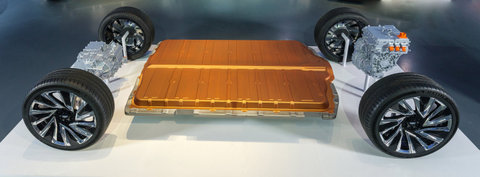
That still leaves four technical questions open for an EV:
- Whether the damage is localized or spread across multiple systems.
- Whether the whole vehicle can be safely restored.
- Which unaffected components retain useful life.
- Whether the traction battery qualifies for further use.
The Battery Needs its Own End-of-Life Decision
From the auction lot alone, battery condition can only be screened. Compare damage photos with the high-voltage battery location in the manufacturer’s rescue sheet. Underbody impact, floor or rocker deformation, flood, fire and electrical damage deserve closer attention. Check the VIN for open battery or high-voltage recalls.
Auction status adds context, not a diagnosis. Copart’s Run & Drive means the vehicle started, went into gear, and moved forward under its own power when inventoried. It does not measure capacity or state of health. A no-start condition does not prove traction-battery failure because a low-voltage fault can also keep some EVs from reaching Ready. Dashboard warnings, displayed charge, mileage and history are clues only.
A pre-bid inspection can add photos or video, but Copart does not allow diagnostic code readers in the yard. Full BMS evaluation may therefore have to wait until the vehicle is accessible after purchase.
What the lot cannot establish:
| Battery question | What the lot can tell you | What requires vehicle access |
| Usable capacity | Not reliably measurable | Capacity and voltage-behavior testing |
| HV electrical safety | Damage location may show risk | Isolation, BMS, connector and HV-system checks |
| Localized or pack-wide degradation | Photos and mileage cannot show it | Voltage balance, resistance and thermal behavior |
| Suitability for another use | Cannot be confirmed | Measured condition matched to that application |
NREL treats battery state, technical suitability for a specific next use and economics as separate decisions. The vehicle and the battery do not necessarily reach end of life at the same time. A safe pack may remain in automotive service. A repairable fault may support specialist repair, while a pack no longer suited to automotive duty may qualify for another verified use. If none is appropriate, the question shifts from battery function to material value.
When Reuse Ends, Material Value Remains
Once a traction battery is ruled out for safe repair or reuse, its chemistry becomes part of the buyer’s downside calculation. NMC and NCA cathodes contain nickel and cobalt, while LFP cathodes use iron and phosphate. Lithium, graphite, copper and aluminum are also common battery materials that may be recovered. An end-of-use LFP pack and an end-of-use nickel-rich pack therefore should not be assumed to have the same recycling economics.
That does not give the pack a guaranteed cash value. A damaged, defective or recalled lithium-ion battery can require special packaging, and U.S. rules prohibit transporting such batteries by air. Recycler acceptance, distance, pack condition and processing costs can reduce what recovery is worth.
Recycling methods also preserve value differently. Pyrometallurgy uses high-temperature processing, hydrometallurgy uses chemical recovery and direct recycling aims to preserve more of the cathode material’s engineered structure.
Before counting material recovery in a totaled EV’s residual value:
- Identify the battery chemistry and pack configuration.
- Confirm that an EV-battery recycler will accept the pack in its current condition and determine transport requirements.
- Compare recoverable value with removal, packaging, transport, and processing costs.
Reuse preserves battery function. Recycling preserves material value after that function can no longer be used safely or effectively. For a totaled-EV buyer, recycling is a fallback path, not a reason to overpay for the lot. Circularity means preserving the highest value that can still be recovered safely before materials return to the supply chain.
