
This article may contain affiliate links.
If you are sourcing a metal component and weighing these two processes, the honest answer is that neither one wins every time. They solve different problems. This guide walks through the engineering trade-offs so you can match the process to the part, the volume and the budget rather than guessing.
Die casting is a forming process. Molten metal gets injected under high pressure into a steel mold, called a die, where it cools and takes the shape of the cavity. Once the die exists, every shot produces a near-finished part in seconds. The catch is that the die itself is expensive to design and cut, and changing the geometry later means new tooling.
CNC machining is a subtractive process. A computer-controlled mill or lathe removes material from a solid block or bar until the part remains. There is no mold. You feed the machine a program, clamp the stock, and the cutters do the rest. Because the geometry lives in software, you can revise a design overnight and run a new part the next morning.
So the core split is forming versus cutting, and reusable tooling versus no tooling. That single difference drives almost everything else: cost curves, material options, tolerances, lead time, and how you have to design the part.
When is die casting the better choice?
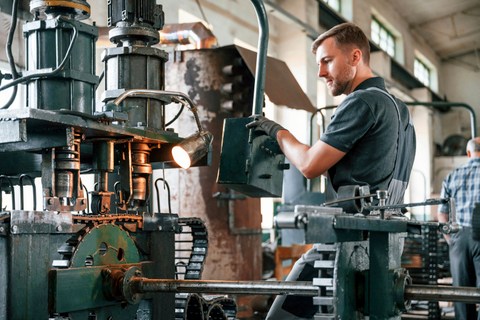
Die casting earns its place when you are making a lot of the same metal part and the geometry is stable. A few signals point this way:
- High annual volume. Once the die is paid for, the marginal cost per part drops sharply. The more parts you run, the more that tooling investment spreads out.
- Complex shapes that would be slow to machine. Castings can form thin walls, internal ribs, bosses and intricate contours in one shot. Cutting all of that from solid would burn hours of machine time per piece.
- Light alloy parts. Die casting works best with aluminum, zinc and magnesium alloys. These flow well, cool predictably and release cleanly from the die.
- Consistent repeatability across a long run. Every part comes from the same cavity, so dimensional consistency stays high across thousands of units.
Think enclosures, housings, brackets, gearbox cases and structural components produced in the tens of thousands or more. For those, casting is usually the lower total cost even though the first part is expensive.
When is CNC machining better?
CNC machining is the right call when flexibility, precision or low volume matters more than per-part forming speed:
- Lower volumes. With no tooling to amortize, one part costs roughly the same as the hundredth. For prototypes, short runs and small batches, that math favors machining.
- Tight tolerances and fine surface finish. Machining holds tolerances that as-cast parts cannot match without secondary work. If a feature has to fit within a few thousandths of an inch, cutting it is the reliable path.
- A wide material range. CNC handles steels, stainless, titanium, brass, copper, and engineering plastics in addition to the same aluminum and zinc you would cast. If your part needs a high-strength steel or a specialty alloy, machining keeps the door open.
- Frequent design changes. Revise the model, regenerate the toolpath, run the part. No new mold, no waiting weeks for tooling.
- One-off and custom geometry. Fixtures, jigs, test articles and replacement parts rarely justify a die.
The limit is throughput at scale. Each CNC part takes real machine time, so once you are making large quantities of the same component, the cumulative cutting hours can outweigh a casting die’s upfront cost.
How do cost and volume compare?
This is where most decisions actually get made, so it is worth being concrete about the shape of the cost curve rather than the absolute numbers, which vary by part.
Die casting carries a high fixed cost (the die) and a low variable cost (each shot). CNC machining carries little to no fixed cost and a moderate, roughly flat variable cost per part. Plot those two lines and they cross at a break-even volume.
- Below break-even: CNC machining is cheaper in total. You avoid the tooling bill entirely, and the per-part cost is acceptable across a modest quantity.
- At break-even: the two approaches cost about the same in total.
- Above break-even: die casting pulls ahead and keeps widening its lead as volume climbs.
Where that crossover sits depends on part complexity, alloy, die cost and cycle time. A simple part with cheap tooling breaks even sooner; a large, intricate die pushes break-even higher. The practical takeaway is to estimate your real annual and lifetime volume first, then ask which side of the crossover you land on. Decisions made on the per-part quote alone often miss the tooling line item that dominates low-volume casting economics.
“We tell clients to choose the process by total project cost and volume, not by the lowest per-part quote,” says Gavin Yi, Founder and CEO of Yijin Solution, a custom parts manufacturer. “A cheap unit price can hide an expensive die you will never amortize, or it can be the obvious answer once the volume is high enough. The numbers decide, not the headline.”
How do materials, tolerances, and finish differ?
Materials. Die casting is largely confined to aluminum, zinc, and magnesium alloys, with each offering its own balance of strength, weight, and castability. CNC machining covers those plus steels, stainless, titanium, copper alloys, and a broad set of plastics. If material choice is driving the part, machining gives you more room; if a light cast alloy already meets the spec, casting is efficient.
Tolerances. Machined parts generally hold tighter tolerances straight off the machine. As-cast tolerances are looser because the metal shrinks and moves as it solidifies. That does not rule casting out; it means the tight features often get machined after casting rather than relying on the cast dimension.
Surface finish. Die castings come out with a smooth skin suitable for many applications and for finishing like powder coat or anodize. Machined surfaces can be brought to very fine finishes where required, controlled by tooling and feed rates. Both can be finished further, so the question is usually how much finishing the as-produced surface saves you.
What design considerations matter for each?
The two processes ask for different things from the CAD model, and designing for the wrong one wastes money.
Designing for die casting:
- Draft angles. Walls need a slight taper so the part releases from the die. Forgetting draft is one of the most common casting design errors.
- Uniform wall thickness. Even walls cool evenly and avoid porosity, sinks and warping. Thick sections trap heat and cause defects.
- Generous radii and ribs. Rounded corners and ribs add strength and help the metal flow, instead of sharp internal corners that stress the part.
- Tooling-aware features. Undercuts and complex internal geometry may require slides or added die complexity, which raises tooling cost.
Designing for CNC machining:
- Fixturing and workholding. The part has to be clamped and reoriented to reach every feature. Hard-to-hold shapes add setups and cost.
- Tool access. Deep pockets, sharp internal corners (a cutter is round) and tall thin walls are slow or impossible to cut cleanly. Design for the geometry a tool can actually reach.
- Minimize setups. Every time the part is re-fixtured, you add time and a small risk of misalignment. Features grouped to limit setups machine faster.
- Reasonable tolerances. Calling out tight tolerances on every dimension drives cost; reserve them for the features that truly need them.
Getting the design-for-manufacturing (DFM) review done early, before tooling is cut or stock is ordered, is where most of the savings live.
Can you combine the two?
Often, yes, and the hybrid is frequently the smartest answer. You cast the part to get its bulk geometry quickly and cheaply at volume, then machine only the critical features that need tight tolerances or fine finish: bearing bores, mating faces, threaded holes, sealing surfaces.
This plays to each process’s strength. Casting handles the complex shape and the volume; machining handles the precision where it matters. You pay for tight tolerances only on the few features that require them, rather than machining the whole part from solid or accepting loose cast dimensions everywhere.
The hybrid does add a second operation and the logistics of moving parts between processes, so it makes the most sense when volume is high enough to justify the die and a handful of features demand machined accuracy.
How do you decide?
Run through these questions in order:
- What is the realistic annual and lifetime volume? Low and uncertain points to CNC. High and stable points to die casting.
- Is the design final? If it is still changing, machining keeps you flexible until it settles.
- What alloy or material does the part require? A light cast alloy favors casting; steel, titanium or plastic favors CNC.
- How tight are the critical tolerances, and how many features need them? A few precision features on an otherwise simple part may point to a cast-then-machine hybrid.
- What is the lead time pressure? Prototypes and quick turns favor machining; long planned production runs can absorb tooling lead time.
- What is the total project cost, including tooling and any secondary operations? Compare totals across the expected volume, not the unit price in isolation.
If you answer those honestly, the process usually selects itself. The grey area is medium volume with a few tight features, and that is exactly where the hybrid earns its keep.
The Yijin Approach
Because Yijin runs both die casting and CNC machining in house, the recommendation it gives is not tied to selling one process. With 25+ years of manufacturing experience and 150+ advanced CNC machines, Yijin produces over 500,000 precision parts a year for 10,000+ clients worldwide, and it can run either process or the cast-then-machine hybrid depending on what the part and volume call for.
That matters because a shop that only owns one process tends to recommend that process. With both approaches available plus a DFM review up front, Yisim’s advice tends to address the specific customer need. Yijin’s CNC machining services even come with a DFM review that can pressure-test the design and the process choice before any tooling is committed.
Yijin also employs quality control by following AS9100D, IATF 16949, ISO 13485 and ISO 9001 certifications across the relevant work. There is no minimum order, so runs span from one part to 100,000+, prototyping typically lands in 3-7 days, and production runs generally complete in 2-4 weeks.
Frequently asked questions
Is die casting cheaper than CNC machining? Per part at high volume, usually yes, once the die is paid off. In total at low volume, no, because the tooling cost has nowhere to spread. Compare total project cost across your expected quantity rather than the unit price alone.
Can die-cast parts be machined afterward? Yes. Casting then machining the critical features is a common hybrid. You get the casting’s speed and low per-part cost for the bulk shape, plus machined accuracy where tolerances are tight.
Which process holds tighter tolerances? CNC machining, straight off the machine. As-cast tolerances are looser because metal shrinks and moves as it solidifies, which is why tight features are often machined after casting.
What materials can each process use? Die casting mainly uses aluminum, zinc, and magnesium alloys. CNC machining covers those plus steels, stainless, titanium, copper alloys and a wide range of plastics.
How many parts justify a die casting tool? It depends on part complexity and die cost, but the rule is to find the break-even volume where casting’s lower per-part cost overtakes the upfront tooling. Below it, machine; above it, cast.
Which is faster for a first part? CNC machining, almost always. There is no tooling to cut, so a prototype can be running in days rather than the weeks a die typically takes to build.
