
This article may contain affiliate links.
What Counts as a Kei Truck – Why Engine Size Matters
A full-size pickup and a kei truck are different machines. Kei jidosha is the Japanese light-vehicle class that covers these vehicles.
Pennsylvania’s driver and vehicle agency, PennDOT, uses a definition that captures the class well. A mini-truck, in that state’s framing, has four wheels, is used primarily to transport property, and has an engine displacement of 660cc or less, an overall length of 130 inches or less, a height of 78 inches or less and a width of 60 inches or less.
Four model names dominate the category: the Honda Acty, Suzuki Carry, Daihatsu Hijet and Subaru Sambar. The Honda Acty’s third generation used a 656cc three-cylinder E07Z engine; a later 660cc 12-valve version was rated at 53 PS or 52 hp at 7,000 rpm. The fourth generation, built from December 2009 to April 2021, used a 658cc E07Z. Buyers comparing a Suzuki Carry with a Daihatsu Hijet or a Subaru Sambar will find the engine and body specifications differ by generation, so the build date matters as much as the badge.
Fuel Economy: Owner Reports, Not Lab Numbers
Owner-reported combined fuel economy for these vehicles falls roughly between 28 and 43 mpg, according to a compilation by Oiwa Garage. The figures below come from individual owners logging their own fill-ups. Treat them as a useful signal, not a controlled measurement.
Single-owner averages recorded on Fuelly give a sense of the range. A 1998 Honda Acty averaged 34.4 mpg, a 1996 Suzuki averaged 32.4 mpg, a 1993 Subaru Sambar averaged 30.2 mpg and a 1991 Daihatsu Hijet averaged 28 mpg. Each figure reflects one owner’s habits and routes, so the spread between them says as much about use as about the machine.
Japanese ratings require a separate caution. Japan’s 10-15 mode test runs at an average speed of 14.1 mph, while pre-2008 EPA city cycles average 21.2 mph. The gentler Japanese cycle produces more flattering numbers, so a factory sticker from Japan will not translate directly to American use. These vehicles are efficient because they are small and light, but their engines are based on designs that are decades old, and they carry no modern emissions hardware.
Kei Trucks For Sale in Texas: Street Legal After SB 1816
Texas is the clearest example of how a state can change the picture for these little trucks. The Texas Department of Motor Vehicles issued Registration and Title Bulletin 001-24 on April 4, 2024, aligning its policy on these vehicles. The legislature then acted. Senate Bill 1816, passed in the 89th Legislature in 2025 on a 31-0 Senate vote, adds a defined category called a “miniature vehicle” to the Transportation Code. A miniature vehicle is designed to propel itself with four or more tires on the ground and complies with applicable federal law. It excludes custom vehicles, street rods, neighborhood electric vehicles, golf carts and off-highway vehicles.
The bill treats these vehicles as motor vehicles for titling and registration. A miniature vehicle may operate on a public highway only if it is registered and titled in Texas and is capable of operating in compliance with applicable traffic laws. The Specialty Equipment Market Association backed the bill, and Colorado passed the similar HB 1281 in the same year. Car and Driver magazine noted that the Texas law never uses the kei label. It creates a broader category, and kei-class models that are 25 or more years old may qualify under the federal exemption.
Anyone browsing kei trucks for sale in Texas should expect to find mostly imported mini-trucks that are at least 25 years old, with some dealers, such as a San Antonio importer, stocking them. Rules elsewhere differ widely. NHK World-Japan reported in November 2026 that Pennsylvania allows registration, while other jurisdictions restrict or prohibit the vehicles. Before purchase, buyers should confirm the rules in their own state.
The VIN step deserves attention. A TxDMV bulletin dated April 23, 2026, requires a Law Enforcement Identification Number Inspection, on Form VTR-68-A, for mini vehicles imported into the United States that were last titled or registered in another country. Title transactions with nonconforming VINs are rejected as invalid and sent to the department for special handling.
The 25-year Rule: Federal, Counted from Build Date
The federal exemption that lets these imports enter the country is found in 49 U.S.C. 30112(b)(9). It exempts a motor vehicle that is at least 25 years old. The importer declares under 49 CFR 591.5(i)(1) that the vehicle is 25 or more years old. NHTSA states that the period runs from the date of manufacture, not the model year. A mini truck built in December 2001 therefore becomes eligible only in December 2026, and vehicles built in 2002 become eligible month by month in 2027.
The EPA has its own threshold. Pennsylvania’s FAQ notes that imports must meet EPA standards unless they are 21 or more years old at importation. The EPA counts that 21-year period by calendar year on Form 3520-1, which means the 25-year Department of Transportation clock is the binding one for most imports.
Importing a truck and operating it on public roads are separate questions. The federal exemption allows the vehicle to clear customs. Registration is decided by each state. Pennsylvania’s FAQ also notes that NHTSA has advised it does not endorse mini trucks on public highways, since they are not built to US safety standards.
Farm, Ranch and Fleet Duty: Where a Small Truck Makes Sense
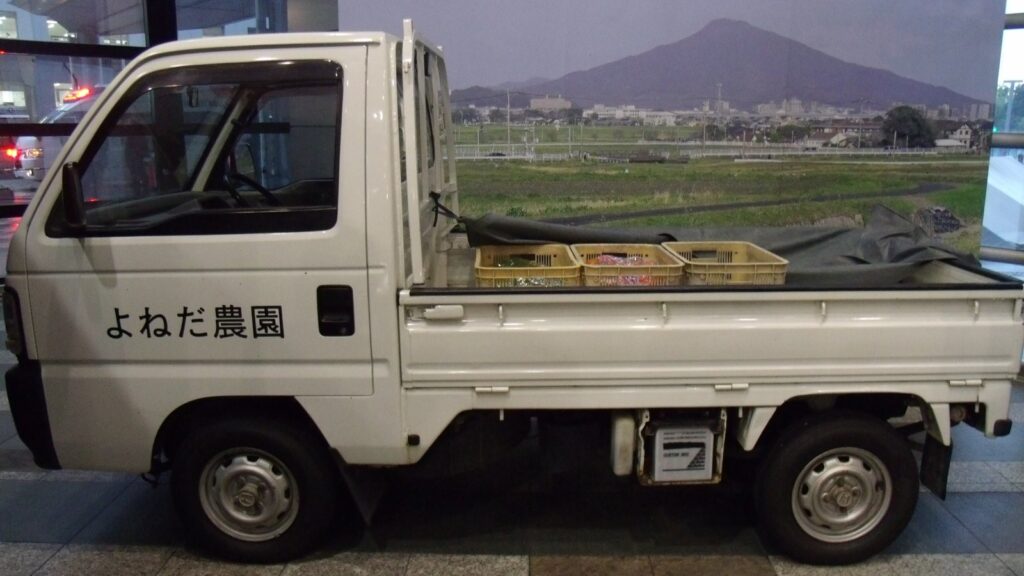
These small trucks were built for work. Their small size and light weight suit tight yards and small loads. The photo below shows one on farm duty in Japan, with harvest crates in the bed.
In the United States, the most sensible uses are on ranches, across large private properties, on campuses and along low-speed local routes. Pennsylvania’s guidance notes a separate path for mini-trucks imported as off-road vehicles, which must be permanently limited to 25 mph and certified to meet non-road emission standards. That is a different category from a mini-truck registered for ordinary road use. These machines are not made for interstate speeds, and a fleet manager should plan routes accordingly.
Safety and Emissions: the Trade-Offs to Price In
Mini-trucks are built to Japanese standards, not U.S. standards. NHK’s reporting in November 2026 pointed to features that many older models lack, including airbags, limited crash protection and lower maximum speeds. PennDOT’s FAQ states that vehicles built before 1998 were not subject to crash testing in Japan. None of these imports carry U.S. emissions certification. Buyers should regard them as low-speed utility vehicles rather than as substitutes for modern passenger cars, and weigh the lower purchase price against the condition and safety gaps.
What to Check Before You Buy
A careful buyer should work through a short list before spending any money, evaluating each mini-truck based on its own history:
- Build month against the 25-year date. The vehicle must be at least 25 years old, measured from its month of manufacture.
- VIN and export paperwork. The VIN on the vehicle must match the documents, and foreign-titled imports need Form VTR-68-A in Texas.
- Title status and registration. Confirm that the state will title and register the vehicle before you pay.
- Model and drivetrain. Decide whether a two-wheel-drive or four-wheel-drive layout suits the job, and match the model to the work.
- Rust and engine condition. Ask for a physical inspection, paying close attention to the underbody and the engine’s service history.
- Shipping and titling location. Settle where the vehicle will be shipped and in which state it will be titled.
- Inspection documentation. Ask the seller for written records of inspections and service.
Dealers that import these vehicles often describe their own inspection steps. JDM Drive, a licensed Texas used-car importer in San Antonio, says its inspectors in Japan check each vehicle before shipping and that vehicles are serviced after arrival in Texas. Those claims are the dealer’s own and should be verified through the documentation listed above.
