
This article may contain affiliate links.
Want your fleet running like a well-oiled machine?
Operating a contemporary fleet is no easy task. The line between a profitable operation and a money pit is often one thing—Service Truck Upfitting.
When techs are missing the proper upfits, they spend hours driving back to the shop to pick up tools, change tanks or dump waste fluids. Every one of those trips is money out of your pocket:

- Fuel
- Labor hours
- Lost productivity
The good news? A properly upfitted service truck flips the script.
In this article, learn how upfitting, particularly when done right with waste oil recovery tanks, can change the way your fleet operates.
Let’s jump in!
Quick rundown:
- Why Waste Oil Recovery Tanks Matter
- Why Upfitting Is Critical For Modern Fleets
- 5 Key Upfits Every Service Truck Needs
- How Upfitting Saves Fleets Money
Why Waste Oil Recovery Tanks Matter
Let’s start with one of the most important upfits—waste oil recovery tanks.
These are the onboard tanks that capture used oil from the equipment being serviced in the field. Rather than make trip after trip back to the shop, crews can simply drain old oil directly into the tank and keep working.
Consider the volumes. The U.S. Department of Energy estimates over 1.37 billion gallons of used oil were available for potential recovery and reuse in just one year. Fleets that service heavy equipment generate a large portion of that total. Without a suitable recovery system on every truck, that oil gets badly handled, or worse, spilled.
Fleets that mounted waste oil recovery tanks to their service trucks kept fleet running on schedule even during peak demand seasons. Why? Because techs aren’t stopping every couple of hours to dump out old fluid back at the shop. Waste oil recovery tanks help you:
- Cut return trips to base
- Stay compliant with EPA rules
- Reduce spill risks on the jobsite
- Keep service times predictable
And as a bonus, one gallon of used motor oil can provide the same 2.5 quarts of lubricating oil as 42 gallons of crude oil. So recovering it isn’t just smart business–it’s smart for the planet.
The best part? Recovery tanks are available in a variety of sizes and configurations. A small service truck can operate a modest tank for light-duty routes. Lube trucks can haul much larger tanks for large industrial accounts. In either case, your crew spends less time driving and more time working.
Why Upfitting Is Critical for Modern Fleets
Service truck upfitting involves the modification of a vehicle for a particular purpose.
Think about it like this. A stock body pickup truck isn’t much use servicing field equipment. Strap on a crane, compressor, lube system and recovery tanks–and you’ve got a rolling shop.
Here’s why that matters today:
Fleet operators feel pressure from all directions. Recent industry data shows average truck operating costs reached a record $2.27 per mile. Every empty mile drives down margin. Upfitting allows one truck to do the work of three trucks. Now, that’s productivity.
Additionally, demand for customized fleet vehicles is growing rapidly. Logistics, construction, oilfield and industrial service companies all require vehicles that are ready to work from day one.
5 Key Upfits Every Service Truck Needs
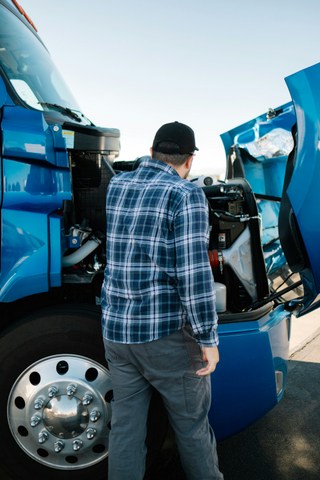
Not all trucks require the same upfits. However, these five essential upfits comprise the baseline for most field service fleets:
Lube & Fluid Delivery Systems
Techs require clean oils, coolants and greases at their fingertips. A proper lube system delivers fresh fluid straight from onboard reservoirs to the point of use on the equipment being serviced. No jerry cans. No mess.
Waste Oil Tanks
Already covered above- but it bears repeating. Coupled with a flow by return delivery system, waste oil recovery tanks complete the circle. Clean fluid out, dirty fluid in. Simple.
Cranes & Hoists
Field techs regularly have to lift heavy parts—pumps, motors, gearboxes, etc. A 6,000-lb. service crane can make a two-person job a one-person job.
Air Compressors
From impact guns to pneumatic tools, the great majority of work in the field is driven by compressed air. Onboard compressors eliminate wait time, and keep cords off your work site.
Tool Storage & Organization
Sounds basic, right? Yet a truck with organized storage allows techs to find the exact tool in seconds. Industry experts agree that “hyper organized” upfits directly improve technician productivity — especially as crews shrink.
How Upfitting Saves Fleets Money
Here’s where it gets interesting. Upfitting is not an expense. It’s an investment. And the ROI is hard to argue with once you crunch the numbers.
Here’s how it works. A properly upfitted service truck can allow one technician to do more jobs per day. That means:
- More billable hours
- Fewer trucks needed on the road
- Less fuel burned on back-and-forth trips
- Lower wear and tear on vehicles
Plus the money from recovered oil. Used motor oil is a legit product—the global waste oil recycling market is expected to hit $5.73 billion by 2030. In fact, some fleets actually make money by selling recovered oil to re-refiners.
Plus, there’s the compliance angle. Mishandling used oil can lead to heavy EPA fines. Proper waste oil recovery tanks protect you from that risk completely.
Think about it like this. Every hour the technician wastes in travel time to resupply is an hour not billable to customers. Every gallon of waste oil mismanaged is a potential penalty.
Upfitting fixes both problems at the same time.
Final Thoughts
Service truck upfitting isn’t a “nice to have” for modern fleets anymore. Rising operating costs, a tightening driver shortage (the latest industry estimates show around 60,000 open trucking jobs) and stricter environmental regulations make every edge is important. Upfitting, particularly with an appropriate waste oil recovery tank, is one of the biggest edges you can offer your drivers.
To quickly recap:
- Upfitting turns a basic truck into a mobile workshop
- Waste oil recovery tanks save trips, time, and fines
- Five core upfits cover most field service jobs
- ROI comes from more billable hours and fewer wasted miles
- Proper recovery keeps you compliant and environmentally sound
Fleets that get serious about upfitting will get far ahead of the game. Those that don’t? Will continue to waste fuel, labor and margin on issues solved years ago. The smart choice is easy. Start planning your next upfit today and put waste oil recovery tanks high on your list.
