
This article may contain affiliate links.
Modern vehicle safety technology is a double-edged sword that often promises more than it can deliver in a split-second crisis. While features like Automatic Emergency Braking (AEB) and Lane Keep Assist are designed to reduce human error, they frequently create a false sense of security that leads to catastrophic lapses in driver attention. In the eyes of the law and physics, these systems are assistants, not replacements, and understanding their hard limits is the only way to navigate the fallout of a high-tech collision.
There are over 16,000 car crashes every day nationally, many of which involve vehicles equipped with advanced driver assistance systems (ADAS), where the technology failed to prevent the impact. This highlights a widening gap between what drivers believe their cars can do and the reality of sensor limitations. When a camera is blinded by a low-hanging sun or a radar sensor is confused by a metal bridge, the burden of safety shifts entirely back to the human behind the wheel.
The Illusion of Autonomous Safety
Most modern cars operate at Level 2 automation, which requires the driver to remain fully engaged at all times. The problem arises when drivers treat these features as “autopilot,” leading to delayed reaction times when the system inevitably encounters a scenario it cannot handle. Heavy rain, snow or even faded lane markings can cause these systems to disengage without warning, leaving an inattentive driver in a precarious position.
Determining liability in these cases is rarely straightforward because it involves a tug-of-war between human negligence and potential hardware failure. If you are involved in such a wreck, it is important to take steps to ensure that the vehicle’s data is preserved as it can be critical evidence in the investigation. This is where support from a legal expert can be helpful. For example, working with a Kansas City car accident lawyer at DM Injury Law may involve initiating legal preservation requests to prevent vehicle data from being overwritten and seeking access to relevant data through insurers, manufacturers or during legal proceedings.
While the exact process can vary depending on the case and location, modern investigations often rely heavily on the digital footprint left behind by a vehicle’s onboard systems. These data points help reconstruct events that a driver may not fully remember.
- The Event Data Recorder (EDR) captures the exact millisecond at which the brakes were applied
- Dashcam footage can verify if lane-keeping sensors were obstructed by environmental debris
- System logs indicate whether the driver’s hands were detected on the steering wheel
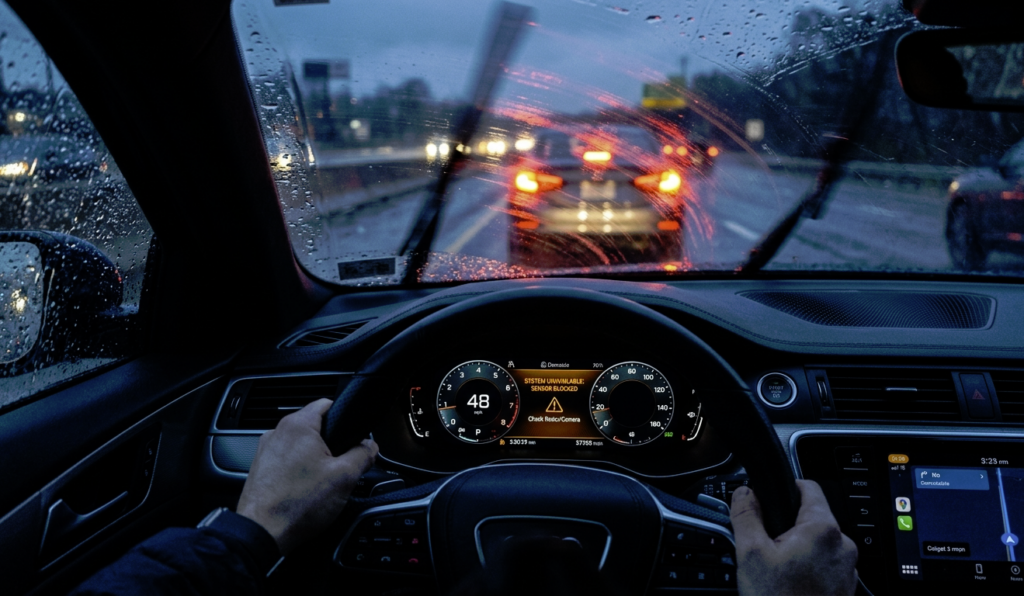
Why ADAS Sensors Fail in Real World Scenarios
Sensors are only as good as the environment allows. While a computer can process data faster than a human, it lacks the contextual intuition to understand complex road behavior. For instance, 40% of drivers misunderstand the functional limits of their braking systems, often expecting the car to stop for obstacles that the sensors are programmed to ignore. On the other hand, advanced braking systems can activate without warning, slowing or stopping when their is no actual obstacle, a phenomena known as “phantom braking.”
A common failure point occurs during “edge cases,” such as an oddly shaped construction vehicle or a pedestrian wearing high-contrast clothing that mimics the background. In these moments, the software may fail to classify the object as a threat. By the time the driver realizes the car isn’t going to stop, the window for evasive action has usually closed.
This tech-heavy environment has changed how insurance companies handle claims. They no longer just look at skid marks; they look at software versions and sensor calibration records. If a system was improperly calibrated after a previous minor glass repair, the liability might shift toward the service center rather than the driver.
Data Recovery and the Burden of Proof
The “black box” in your car is the ultimate witness in a modern personal injury claim. This device records steering angles, throttle position, and whether the ADAS issued a chime or vibration warning before the impact. If the NHTSA transition to Level 3 automation continues, the legal definitions of “operator” will only become more complex.
Proving that a system malfunctioned or that the driver over-relied on a system that had already signaled a fault requires a deep dive into these telematics. It is a level of specificity that traditional police reports often miss. Without a technical analysis of the vehicle’s internal logs, a driver might be unfairly blamed for a crash caused by a software glitch, or a manufacturer might escape accountability for a known sensor defect.
The Long View
Navigating the aftermath of a crash involving driver-assist tech requires more than just a basic understanding of the rules of the road. It requires a forensic look at how the man-machine interface broke down.
To learn more about the legal nuances of modern vehicle tech, check out our other posts and get a handle on where things stand and where they’re headed.
