
This article may contain affiliate links.
A quiet electric motor changes the sound inside a car, but it does not remove everything competing with the stereo. The cabin remains a listening space shaped by the journey as well as the audio system. For podcasts, the useful question is how clearly a conversation comes through, rather than how impressive the equipment looks on a specification sheet.
Spoken-word programs develop through questions, answers and explanations. Their meaning depends on the words being understood, including the connections between one point and the next. The vehicle’s background sound and the system’s reproduction of the recording both belong in that experience. Quietness describes one part of the surroundings; it does not describe everything between a recorded conversation and the listener.
As an example, the Kim Hughes podcast brings bomb-disposal expert Hughes into conversation with presenter Selema Masekela about his work and preparation. It offers an account of an unfamiliar profession through the person who practiced it. Following that account means following the exchanges that develop it, rather than simply registering that a voice is playing. Spoken-word listening brings this kind of conversation into a cabin that already has its own sounds. Enjoying this kind of podcast–where the subject matter might be complex–to the full means creating a setup that allows everything to be heard clearly, maximizing the amount of information you can get from listening.
The Cabin Shapes the Sound from the Speakers
In an August 2025 technical article on automotive audio measurements, Steve Temme reports tests in an unnamed EV parked in a quiet underground garage. He explains that reflections and microphone position affect measured sound. His tests examine frequency response: how strongly a system reproduces different pitches, which shapes the balance of its sound.
Quiet surroundings and faithful reproduction describe different properties. A cabin can have little background noise while the audio system gives different emphasis to different parts of a recording. The recording supplies the conversation, but the reproduced sound is the result of playback through the installed system within the cabin. Electric propulsion does not specify that system’s tonal balance.
Temme’s measurements also differed between seats in the tested car. A vehicle’s occupants therefore need not receive identical reproduced sound, even though they share the same recording and speaker system. This is another reason that an equipment list cannot fully describe listening. Speaker count identifies how many speakers are installed; it leaves the sound reaching each position unmeasured.
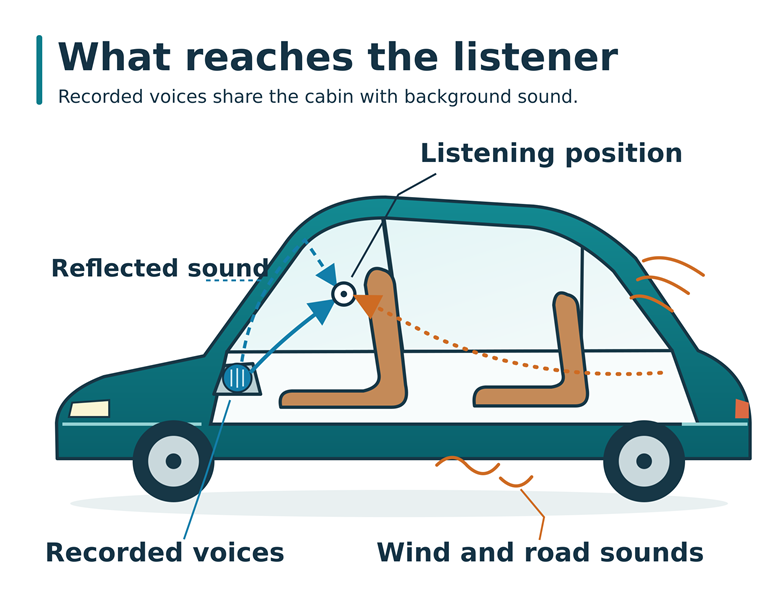
Sound from the speakers reaches occupants within the car’s interior, where it can reflect from surrounding surfaces. The listening position is part of that arrangement. A speaker system is therefore heard in a particular space, from a particular seat, rather than independently of the car around it. This gives cabin design and audio reproduction a direct relationship, while keeping sound produced by movement separate from the way the recording is reproduced through the installed equipment.
Quiet at Rest Is Different from Quiet on the Road
Car and Driver’s July 2026 test of the 2027 Rivian R2 supplies a documented example of the moving cabin. Its Performance AWD Launch Edition, tested with 21-inch wheels, registered 31 dBA at idle and 67 dBA at 70 mph. The reviewers described wind rush and suspension thumps on the highway.
Battery-electric cars have no combustion engine, but wind and road noise remain part of the journey. Describing quietness at rest leaves a separate question about sound while traveling. For spoken-word entertainment, that distinction concerns the surroundings in which the conversation is reproduced. The stereo and the moving car both contribute to the sound reaching the occupants.
The road-test figures measure overall interior sound under the stated conditions. They do not report how clearly individual words were understood or isolate each noise source’s contribution. Likewise, the parked audio measurements describe the system tested in the garage. These are separate vehicles and separate assessments, each explaining a particular part of the listening experience.
The Audio System Can Add Sounds of its Own
In Temme’s unnamed, parked test vehicle, a door panel rattled audibly at a higher playback level. He explains that speaker-driven vibration can affect panels, wiring and fasteners, adding unwanted sound to the audio being reproduced.
Speakers are fitted to the vehicle, so their performance also involves the components around them. A panel that responds audibly to playback introduces a sound beyond the recorded material. This concerns the car’s physical installation, rather than the podcast’s subject or the absence of a combustion engine. It brings the interior into the explanation in a different way from the wind and suspension sounds that accompany movement.
Loudness and Reproduction Quality
The technical article distinguishes maximum output from useful output, judged alongside distortion. Distortion describes changes introduced during reproduction. Assessing it therefore concerns the sound being produced, alongside the level at which the system plays it. That separates how loud a system can play from how well it reproduces the material at that level. A maximum-volume figure describes output; it does not, by itself, describe the quality of a conversation coming through the speakers.
An interview’s questions and answers carry its account of the subject. The car’s sound system reproduces those recorded exchanges within the cabin’s background sound. Equipment specifications identify what is installed, noise readings describe the surroundings, and a listening assessment addresses the result. Each supplies information that the others leave open.
A quiet EV provides a useful starting point for listening, while clear podcast audio depends on what reaches the occupants during playback. The motor, moving cabin and installed sound system have distinct roles. Understanding those roles gives a fuller account of in-car listening than a quietness claim or a speaker count alone.
