
This article may contain affiliate links.
Preparing an EV garage setup requires evaluating ceiling and floor strength, planning a strategic home charging layout, creating safe battery access and choosing versatile equipment to support long-term vehicle maintenance.
Transitioning to electrified driving fundamentally changes how you use your daily parking space. Taking these four practical steps early ensures safer tire management, easier underbody inspections and less structural frustration when organizing a hybrid maintenance space.
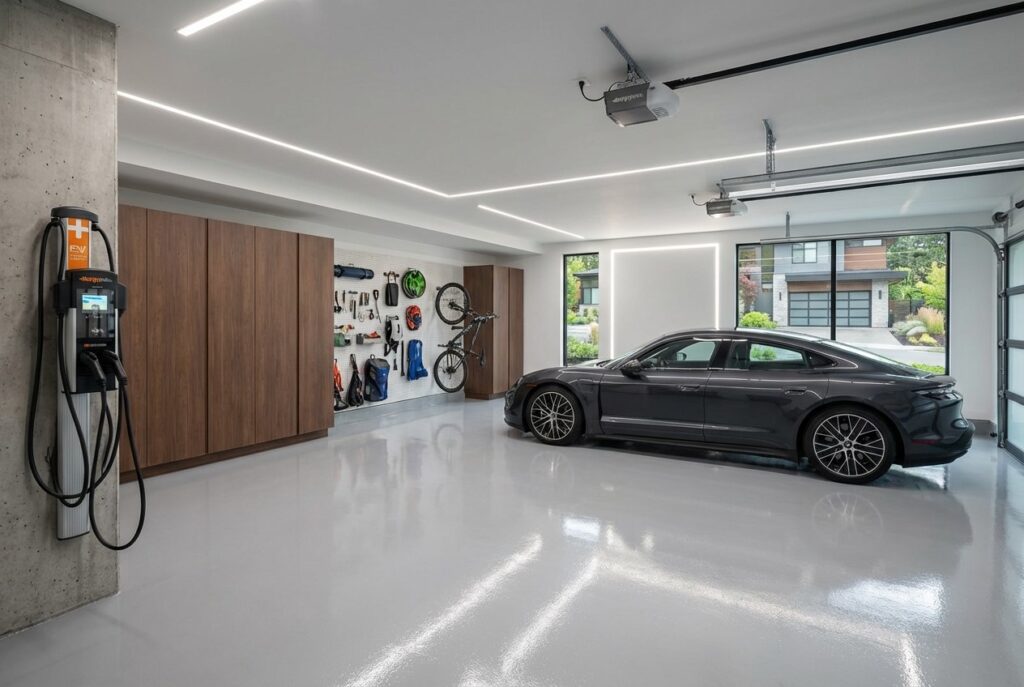
Your Garage Has a New Job
Buying an electric vehicle or plug-in hybrid changes more than your trips to the gas station. It changes how you use your garage every single day.
For most households, the garage has always been a passive space, somewhere to park, store tools and occasionally change a tire. But when an EV enters the picture, that space transforms into an active home base. You are now charging overnight, planning around cord placement, thinking about underbody clearance for battery inspections and storing equipment that needs to work for two very different types of vehicles.
Consider a two-car household bringing home its first EV.
The charger arrives, they realize the outlet is on the wrong wall, the extension cord creates a trip hazard, and there is no clear space to rotate tires on a heavy vehicle with non-standard lift points. None of these problems is complicated, but none of them are obvious until you are standing in the garage with keys in hand.
This guide covers four practical tips for garage planning for electric vehicles. Whether you own one plug-in hybrid or you are a small business preparing for electrified service vehicles, these steps create a safer, more functional setup that supports your vehicles long-term.
1. Evaluate Ceiling Height and Floor Strength
Before you move a single shelf or order any equipment, understand what your garage can physically support. This step costs nothing but time, but skipping it leads to expensive corrections later.
Start with ceiling height, as most standard residential garages measure between seven and eight feet tall. That clearance works for basic parking and general storage, but it limits your options if you eventually want to add overhead storage racks or taller service equipment. Many post configurations require at least 10 to 12 feet of clearance.
If you drive a full-size EV truck or a taller crossover, verify that your garage accommodates the vehicle itself before assuming there is room for anything else.
Ceiling height is not just about your immediate setup. It determines how much your space can evolve as your needs change. Some owners upgrading a serious home shop may consider heavy equipment for inspections and wheel service. Ensuring your floor and ceiling can structurally accommodate a garage lift is a vital early step for workspace flexibility.
Experts at specialized firms like HeavyLift Direct often emphasize that verifying these structural limits early on is the only way to ensure your shop can safely support professional-grade equipment in the future.
Then assess your floor. EVs are significantly heavier than comparable gas-powered vehicles. A full-size electric truck weighs over 6,000 pounds, while a midsize electric crossover comes in around 4,400 pounds. That weight concentrated on a standard residential concrete slab is manageable in most cases, but it becomes a real concern when you add heavy service equipment on top of it.
If you plan to bring in substantial equipment, consult a structural engineer or licensed contractor before making any purchases. A professional assessment is a one-time cost that protects you from structural damage and equipment liability down the road.
Knowing your ceiling and floor limits is the foundation of smart garage planning for electric vehicles. Every other decision builds on what you learn here.
| Warning/Important: EVs are significantly heavier than gas vehicles. Always verify your concrete slab thickness and ceiling clearance before installing heavy equipment to prevent structural damage or safety hazards in your home shop. |
2. Plan Your Charger Placement and Cable Management
Home charging is the daily heartbeat of EV ownership. Where you place the charger and how you manage the cable shapes your routine more than almost any other decision you will make in this process.
Understand your charging options first. Level 1 charging uses a standard 120-volt outlet, adding roughly three to five miles of range per hour in most EVs.
Level 2 charging operates on a 240-volt circuit and delivers 10 to 30 miles of range per hour, depending on the charger and vehicle.
Most EV owners find Level 2 essential for overnight charging that reliably tops off the battery before morning.
Place the charger strategically. Mount the unit on the wall closest to your vehicle’s charge port. This reduces cord strain, keeps the cable taut, and eliminates the need to route it across walking paths. In a two-car garage, consider offset placement or a dedicated bay for each vehicle if a second EV is in your near-term plans.
Manage the cable deliberately to avoid problems. A charging cable left on the floor is a trip hazard and a tire damage risk. Use cord hooks, retractable reels or wall-mounted holders to keep the cable elevated and organized. When the vehicle is connected, the cord should reach comfortably without pulling taut.
Plan for the future now. A household adding its first EV today may add a second within a few years. Running conduit for a second circuit during the initial installation costs a fraction of what a full retrofit will cost later. A good electrician will account for this during planning, so ask specifically about futureproofing the home charging layout before work begins.
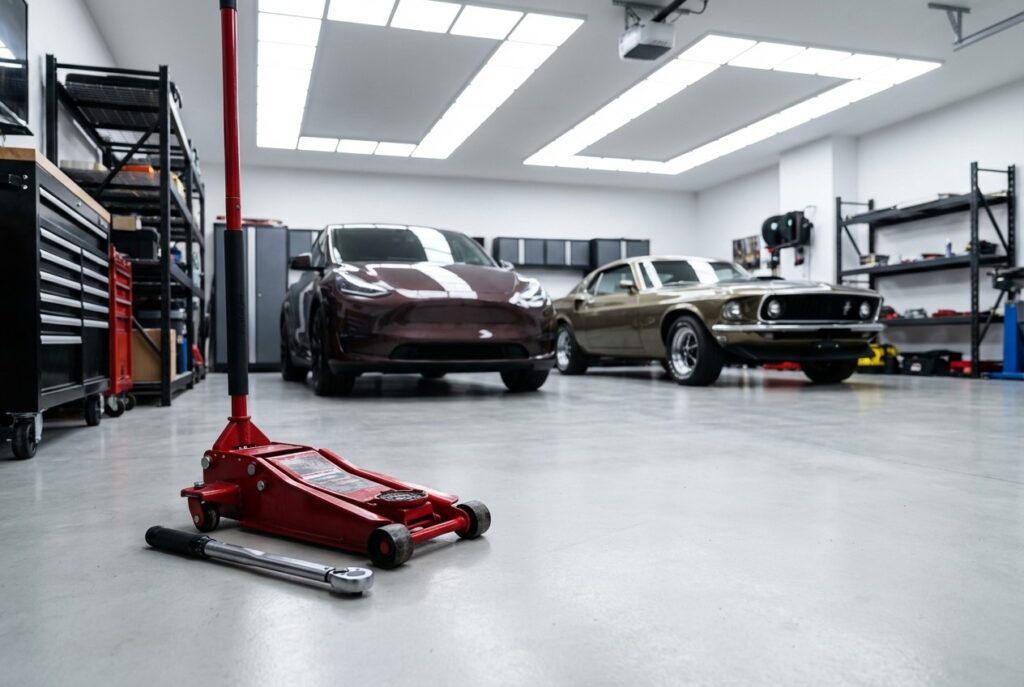
3. Leave Room for Battery-Safe Service Access
EVs require less routine maintenance than gas vehicles. There are no oil changes, no spark plugs and no exhaust system to worry about. However, the service they do need is highly specific, and your garage layout needs to properly support it.
Underbody access is more important with an EV, not less. EV battery packs typically run along the vehicle floor pan, making underbody clearance a priority for inspections and coolant system checks. After long highway trips, off-road use or driving through debris, a visual inspection of the undercarriage helps catch damage early before it becomes a costly repair. Unlike a gas vehicle, where underbody damage is mostly mechanical, an EV battery impact can carry serious safety implications.
Account for non-standard lift points during your planning. EV weight is distributed lower than in gas vehicles because the massive battery pack sits in the floor. That layout completely changes where safe jack points are located on the chassis. Never assume the same support positions you use on a gas vehicle will work on your EV.
Apply basic safety practices around your charging infrastructure.
- The area around your charger and battery access points is not general storage space. Avoid storing flammable chemicals, aerosols or solvents within three feet of the charging station.
- Label any high-voltage components clearly and keep the area well-lit and uncluttered to maintain home workshop safety.
- Designate specific zones within the garage. Separating your space into a charging zone and a work zone dramatically improves safety and usability.
The charging side handles the vehicle at rest, while the work side handles tire rotations, fluid checks and inspections. This organized floor plan is the practical foundation of a functional hybrid maintenance space.
4. Choose Equipment That Works for Gas and Electric Vehicles
Many households run a mixed fleet consisting of one gas vehicle and one EV. The best garage setup serves all of them without requiring you to buy separate tools for each powertrain. Equipment that handles varying vehicle weights, lift point configurations and service needs gives you excellent long-term value.
Pay particular attention to tire service, as EV tires wear noticeably faster than those on gas vehicles. The combination of extra weight and instant torque accelerates tread wear significantly.
Federal safety guidelines note that regular rotation reduces irregular wear, advising that tires should be rotated every 5,000 to 8,000 miles. That frequency makes accessible, organized wheel service a routine part of ownership rather than an occasional project. With so many vehicles on the road, managing tire life is a widespread concern. In fact, data indicates that owners purchase approximately 340 million replacement tires every year.
Organizing your space for larger, heavier vehicles makes this frequent maintenance easier to handle at home. Wall-mounted storage, ceiling racks and vertical organization free up essential floor space for maneuvering wider EVs.
Consider whether your setup calls for structural equipment to assist with these heavier tasks.
For homeowners who are serious about their home workshop, relying on floor jacks has real limitations. Crawling under a heavy truck with a floor jack and jack stands is manageable but not highly efficient. Underbody EV battery inspections are much easier with consistent, stable clearance provided by heavy-duty lifting tools.
A dedicated lifting mechanism supports both current gas vehicles and future EVs, making it a long-term addition to the space rather than a single-vehicle solution. That said, this type of equipment is not for every garage. Structural prerequisites always apply first before making major upgrades. If your ceiling height or floor capacity does not support it yet, the other three tips in this guide still give you a very strong foundation.
This same logic applies to small business owners operating a fleet. A contractor or mobile service operator preparing for electrified service vehicles faces the same versatility challenge on a larger scale. Equipment that grows with the fleet delivers far more value than tools that must be replaced with each new vehicle type.
| Key Insight: Building a versatile garage means choosing tools with higher weight capacities and flexible lift points. This futureproofs your workspace, allowing you to maintain a mixed fleet of gas and electric vehicles efficiently. |
The Bottom Line
Smart garage planning for electric vehicles is not a one-time project. It is an ongoing investment in smoother daily ownership, better vehicle care and less time problem-solving in a space that should be working for you.
Knowing what your space can structurally support before you plan anything else is the first critical step.
Place the charger where it works best and wire for future needs while the walls are still open. Keep service areas organized, safe, and built around EV-specific access requirements. Choose equipment versatile enough to serve every vehicle in your driveway, now and into the future.
As more households transition to mixed or fully electric fleets, the garage becomes as important to ownership as the vehicle itself. A family that spends a weekend mapping their charging zone and organizing their service area before the EV arrives will hit the ground running.
Conversely, improvising your setup often leads to working around a tangled cord, a cluttered floor and a space that never quite fits.
The gap between those two experiences comes down to a few practical decisions made early. Start with the space you currently have, assess it honestly and build systematically from there. Proper planning will consistently reduce ownership friction, protect vehicle value and make the transition to electrified driving much easier for households with mixed powertrains.
