
This article may contain affiliate links.
The Fourth of July pushes American highways close to their limit. For the Independence Day holiday period, AAA projected 72.2 million Americans would travel, with roughly 61.4 million of them making the trip by car. The regional picture was just as heavy: about 2.13 million Virginians were set to travel 50 miles or more during the same window. That density turned into collisions fast. Virginia State Police reported 892 crashes over the holiday weekend, resulting in 15 deaths across 14 separate crashes during the July 2 through July 5 enforcement period. Even before the holiday, officers had already logged 307 deaths on Virginia roadways through June 30, prompting urgent calls for slower speeds and sober driving.
If you are driving an electric vehicle or plug-in hybrid, heavy traffic turns route planning into a genuine safety issue. Congestion, brutal summer heat and long queues at public chargers can eat through the buffer you would normally build into a trip. Electrified powertrains are impressively efficient, but running a battery’s state of charge too close to zero strips away your ability to handle an unexpected detour. Because a minor charging miscalculation can quickly turn into a roadside hazard in heavy traffic, scheduling charging stops well before the battery gets uncomfortably low is essential. Keeping a generous margin ensures a sudden highway closure or a broken fast charger will not force your family into an emergency stop beside live traffic.
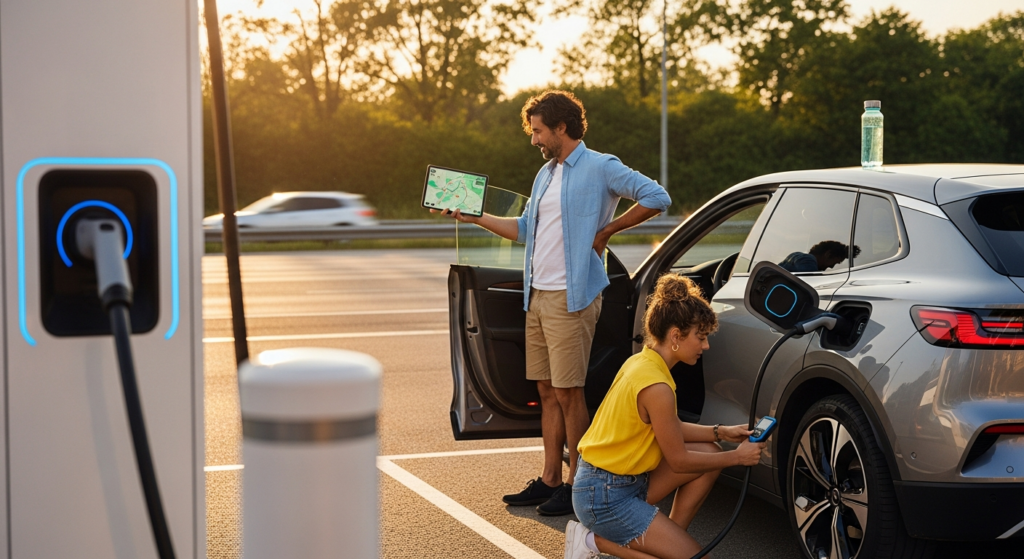
Holiday EV Road Trip Safety Starts Before Departure
Route planning should prioritize charging margin, not theoretical range
Drivers heading out on long trips often try to stretch the distance between chargers to the absolute max. But real-world range swings a lot depending on speed, air conditioning and how much weight you’re hauling in passengers and cargo. High-speed cruising burns energy far faster than city driving, so a car packed with luggage may never hit its advertised lab range. Holiday congestion piles on reroutes and long stop-and-go stretches, both of which scramble your energy math. The same operational challenges shape sustainable freight and the future of long-haul EV trucks, where fleet managers have to factor in weather and weight to keep deliveries on schedule. Arriving at a charger with a healthy percentage left protects you if your first choice is occupied or offline. Hybrids benefit from conservative fueling, too, since fatigue creeps in when you push through too many hours without a real break.
Tire pressure, tread, and load matter more in summer travel
Summer heat is hard on tires, which makes preventive maintenance a must before any holiday weekend. High temperatures make the air inside a tire expand, which can change how the vehicle handles and how efficiently it runs. Pile in a full load of family and vacation gear and you stress those tires further, potentially lengthening braking distances and cutting maneuverability.
For example, the Virginia Department of Transportation regularly tells drivers to pack essential emergency supplies like water and first aid kits before extreme summer travel. Check tire pressure while the tires are cold, inspect tread depth, and confirm you’ve got a roadside inflation kit or a spare. It’s worth a quick look at coolant, washer fluid, and wiper blades too before you merge onto a packed interstate. AAA experts warn that basic mechanical neglect plus extreme heat frequently leads to increased breakdowns and stranded motorists during peak travel windows.
Thorough pre-departure preparation reduces the chance of emergency pull-offs where legal and safety complications compound. In heavy holiday traffic, a stalled EV on a shoulder creates immediate hazards, often raising questions about who is at fault for hitting an illegally parked car. Understanding how law enforcement and insurers evaluate an illegally parked car fault highlights why maintaining a robust battery reserve is vital—ensuring you reach a designated exit or rest station rather than stranding your vehicle near live traffic lanes.
| Travel Variable | Effect on EV/Hybrid Trip | Safety Risk if Ignored | Practical Adjustment |
| High speed | Increases energy use | Late charging stop, rushed driving | Leave earlier, charge sooner |
| Heavy cabin cooling | Reduces range modestly | Overconfidence in projected range | Build in a larger buffer |
| Full passenger/cargo load | Adds weight | Longer braking, reduced efficiency | Check tires and plan shorter legs |
| Charger queues | Delays stop timing | Fatigue, low-state-of-charge stress | Identify backup chargers |
| Summer heat | Affects comfort and tires | Driver fatigue, tire problems | Inspect tires, carry water |
Charging Timing and Fatigue Management Are Linked
A safer charging strategy is also a safer rest strategy
Highway safety experts keep pointing out that managing human fatigue matters as much as managing the battery. Earlier charging stops keep the pack from running low while giving everyone a real physical break. If you’re traveling with young kids, older passengers or pets, structured recovery windows take a lot of the stress out of long hours in a cramped cabin. During a charging session, you can hit the restroom, hydrate, walk around the car for a quick inspection and double-check that the child seats are still locked in tight. Rolling into a station on a single-digit charge might look efficient on paper, but is that really worth the stress the moment traffic suddenly stops? Think of the stop as a mandatory pause that resets your focus, not just an electrical top-up. Line your charging up with human rest cycles, and the next leg stays calmer and more controlled.
Driver-assistance features should support attention, not replace it
Modern EVs often pack sophisticated driver-assistance systems built to ease the workload of long highway stretches. Adaptive cruise control, lane centering and navigation-based energy prediction are genuinely handy when everything’s working under ideal conditions. Check those settings before you leave, especially if your route crosses unfamiliar regional highways. These systems can struggle in messy environments: active work zones, faded lane markings, unpredictable holiday stop-and-go. Distraction, speeding and fatigue are still among the biggest causes of highway crashes, no matter how much tech is baked into the car.
Over the recent holiday, for example, Virginia State Police issued a startling 3,153 speeding citations plus another 1,540 summonses for reckless driving. They also logged 70 DUI arrests, proof that human error still dictates road safety far more than any automated steering feature.
Five pre-departure checks for an EV or hybrid holiday trip:
- Confirm the first two charging or fueling stops and identify a secondary backup.
- Check tire pressures when cold; inspect tread depth and sidewall integrity.
- Verify child restraints, seat belts and heavy cargo placement.
- Review driver-assistance settings, map routing and live charging network filters.
- Pack water, charging cables, reflective safety gear and basic first-aid supplies.
Why Shoulder Stops Are Especially Risky During Holiday Travel
Low range should not force a hazardous roadside decision
Letting your energy reserves run all the way down can push you into a genuinely dangerous choice: pulling onto a narrow highway shoulder. The moment you stop there, you and your passengers are exposed to the kinetic energy of traffic screaming past. Emergency responders keep urging drivers to obey “Move Over” laws, because a stationary vehicle is a serious collision risk for motorists and roadside workers alike. At a mock crash demonstration before the holiday, safety advocates showed how easily distracted drivers drift into stationary vehicles and guardrails along busy corridors. A shoulder is not a substitute for a charging plan; it exists for real, unavoidable mechanical emergencies. If your car still has enough power to move safely, reaching a proper exit, a well-lit lot, or an official rest pull-off beats sitting there every time. Lingering near live lanes ramps up the odds of a secondary crash, especially when holiday traffic leaves other drivers little room to change lanes.
Parked and illegally stopped vehicles create complex crash scenarios
When a stalled, disabled or improperly stopped vehicle blocks a travel lane or a tight shoulder, it instantly becomes a complicated crash hazard. Those scenarios get especially dangerous at night or in heavy congestion, when approaching drivers have almost no time to react. If you experience a roadside interruption, put scene safety first: turn on your hazard lights, move somewhere secure if the car can still roll, and contact roadside assistance or law enforcement.
Most holiday snarls end in nothing worse than a delay, but when an impact does happen, sorting out legal liability comes with specific procedural requirements. To follow up on the example we’ve cited, under Virginia Code § 46.2-896, a driver who strikes an unattended vehicle must try to locate the owner and report the incident to law enforcement within 24 hours. Leaving the scene of that kind of property damage can trigger a Class 4 misdemeanor in the state, even when the damage looks relatively minor.
That matters a lot, because Virginia’s fault rules differ sharply from states that use comparative negligence systems. Virginia applies a strict contributory negligence rule, which means a driver found even slightly at fault for an accident may be barred entirely from recovering financial compensation. That rigid framework is exactly why you want to be extra careful maneuvering around disabled vehicles on the highway. In the end, the strict standard is a strong argument for avoiding questionable roadside stops and staying on top of your energy management so the car keeps moving safely.
A Practical Safety Margin Is Part of Efficient EV Travel
Efficiency and safety are aligned when planning is realistic
Transportation analysts keep making the same point: the most efficient trip isn’t the one finished with the fewest possible stops. Running with a moderate energy buffer quietly kills the urge to drive aggressively, rush your merges or gamble on charging. Whether you’re managing a commercial fleet or just loading up the family for vacation, a flexible plan beats a fragile “perfect route” every time. Anyone tracking the prospects and predictions for ICE cars in the next decadewill notice that combustion engines and hybrid systems still hold real advantages for long-distance endurance. But EV drivers can capture most of that peace of mind by penciling in one extra short charging stop each day. Ease the range anxiety with conservative planning, and you’ll naturally drive calmer, which directly supports safer operation in chaotic holiday traffic.
Seat belts, speed discipline, and sober driving still determine outcomes
Advanced powertrains and slick digital dashboards boost efficiency, but old-fashioned safety habits still decide how most highway crashes end. Crash prevention comes down to buckling up, respecting the posted speed limit and never driving impaired. In our Virginia example, crash data drives the point home. At least four fatalities involved unbelted occupants during the July 4 reporting period. State enforcement numbers back it up, with authorities citing more than 1,500 drivers for reckless driving behaviors that bypass any car’s safety engineering. Automatic emergency braking and lane-keeping assistance add valuable layers of protection, but they can’t override the physics of a heavily loaded vehicle crashing at high speed. Safe operation of any clean-energy vehicle still comes down to the choices you make behind the wheel.
The Best Holiday EV Trips Leave Room for the Unexpected
Electric and hybrid road trips are safest when you plan charging stops, maintenance checks and fatigue breaks with a conservative mindset. Heavy holiday traffic makes those built-in buffers even more valuable, since crowded highways multiply the risks of rushed decisions and low battery levels. Refuse to stretch your range to the bitter end, and you keep the margin needed to handle unpredictable detours and dead chargers safely. Electrified transportation keeps maturing alongside better infrastructure planning, giving families cleaner options for seasonal highway journeys. The best holiday drives, in the end, are the ones where getting there safely matters far more than squeezing out theoretical maximum efficiency.
