
This article may contain affiliate links.
A dashboard battery warning that won’t clear. A hard underbody strike on a rural two-lane. In the minutes after an electric vehicle collision, EV crash safety comes down to a short list of decisions. Most of them favor distance over a close look.
The familiar priorities haven’t changed. Check everyone, including yourself, for injuries, and call 911 when it’s needed. What’s new is the propulsion battery. If that pack is damaged, your job is to stay well back rather than inspect it.
Location also matters. In a sparsely populated state like Wyoming, roads add their own pressure. According to the Wyoming Department of Transportation, speed contributed to 46.4% of the state’s fatal crashes over a 5-year period. In that same period, 68% of speed-related crashes involved driving too fast for conditions. Emergency responses can take longer in remote areas. A high-voltage warning can remain illuminated long after the vehicle has stopped, and you’ll want to pass that information along.
What Makes an Electric Vehicle Crash Different?
The High-Voltage Battery Can Be Damaged Without Obvious Flames
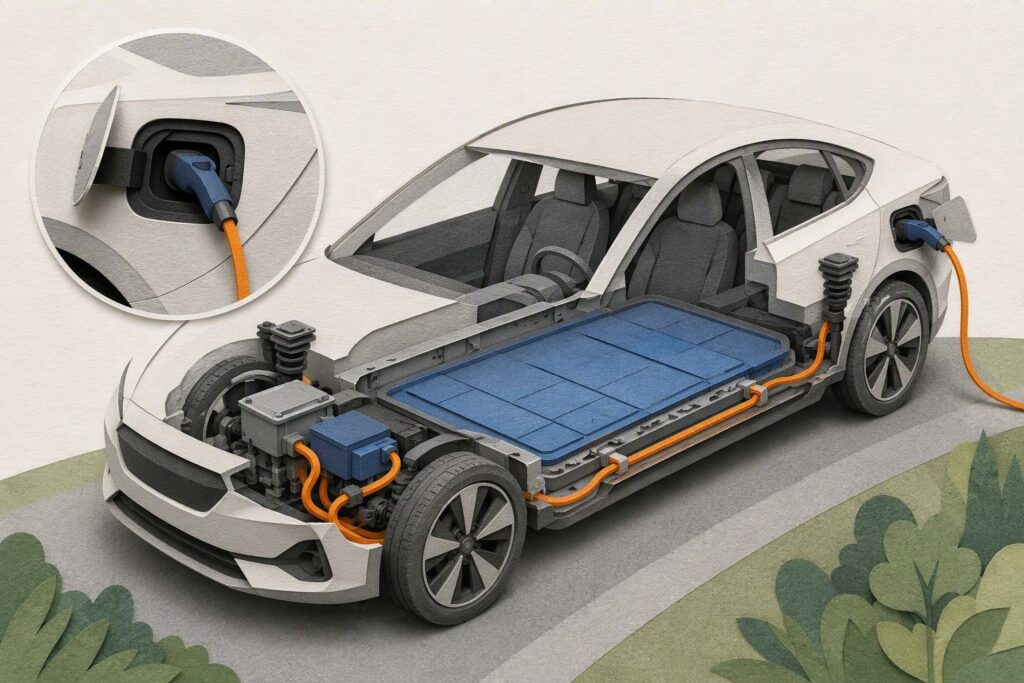
Every electric vehicle has a traction battery, the large, high-voltage pack that stores energy and powers the wheels. It usually sits inside a rigid enclosure beneath the passenger compartment. That placement protects it in most collisions, but it also means you can’t judge the pack’s condition by looking at crumpled body panels.
A hard strike to the underbody is one trigger for concern. So is deep intrusion into the enclosure or a high-voltage warning on the dash. Either one justifies treating the vehicle as potentially energized and unstable. Your job isn’t diagnosis. Observe from a safe position, report what you saw, and follow the post-crash precautions covered in NHTSA’s electric vehicle safety guidance.
Heat or Fire Can Develop After the Initial Collision
An EV battery fire after a crash doesn’t always begin at the moment of impact. The pack can experience thermal runaway, a self-heating failure that spreads between neighboring cells. Warning signs can include increasing smoke or heat, hissing or repeated popping sounds.
A battery warning doesn’t prove a fire is underway. It does mean you should avoid restarting the vehicle or plugging it in, and you should never touch damaged high-voltage components.
Important: Never cut orange high-voltage cables or open battery panels. Stay away from leaked material, and leave any attempt to cool the pack to trained responders.
Here Are the 8 EV Crash Safety Steps to Follow
The order matters almost as much as the steps themselves. This sequence runs from impact to the tow truck.
| Step | What to Do |
| 1 | After a crash, exit only when safe, and watch for traffic, fire, smoke, damaged electrical components and unstable surroundings. |
| 2 | Leave the vehicle if you notice smoke, heat, unusual sounds, leaks or battery warnings. |
| 3 | Move away from traffic without approaching the damaged battery area. |
| 4 | Tell responders the vehicle is electric and describe any warning signs. |
| 5 | Do not touch damaged charging equipment or electrical components. |
| 6 | Photograph warnings and damage only from a safe position. |
| 7 | Preserve records and report the collision when local law requires it. |
| 8 | Arrange towing and storage based on the manufacturer’s instructions. |
1. Stop, Power Down, and Assess Immediate Injuries
Bring the vehicle to a stop as close to the scene as you safely can. Shift into park and set the parking brake. Switch the vehicle off only if everything responds normally, because a system acting up after a crash may signal a problem.
Medical care comes first.
Call 911 for any injury or suspected injury. Call 911 if there’s smoke, the vehicle is in a dangerous road position, or the collision meets Wyoming’s (or other local) reporting requirements. Don’t move an injured person unless staying put poses a more immediate danger. When dispatch answers, tell them how many people were in the vehicle and how many may be hurt.
An injury crash opens a second file after the roadside clears: medical records, a police report and eventually the insurance claim that leans on both. Injured drivers who want attorney-led guidance through that process can consult a Wyoming car accident attorney in our example.
2. Leave the Vehicle if You Notice Smoke, Heat or Battery Warnings
Exit promptly and move well away if anything about the battery looks or sounds wrong: smoke, growing heat, hissing or popping, sparking or a leak. A strong, unusual odor or a high-voltage warning on the dash counts, too. Keep bystanders back, and when you can safely move, avoid standing downhill or downwind of any smoke.
No universal evacuation distance fits every situation, so follow directions from dispatch or arriving responders.
Important: Do not go back for belongings while smoke or heat are present or while any electrical symptom continues.
3. Move to a Safer Location Without Entering Traffic
In our example and elsewhere, Wyoming’s rural roads carry high-speed traffic, often with limited light lines, and weather conditions can change quickly. When you can do so safely, put a barrier between yourself and traffic, or add distance between yourself and the roadway.
A disabled vehicle on the shoulder can leave occupants exposed, so move to a protected location when it’s safe. Don’t cross active lanes or step closer to visible battery hazards to get there.
If the EV is smoking or showing battery warnings after an underbody strike, don’t push it off the road just to improve traffic flow. Police and fire personnel should decide whether it can be repositioned.
4. Tell Responders That the Vehicle Is Electric
Dispatchers and first responders need specifics. Give them the make and model along with your approximate location. Then describe what you observed, including any dashboard alert or visible smoke. Mention an underbody impact, and say whether the vehicle was plugged in when it happened.
Knowing the vehicle is electric changes how responders approach isolation and shutdown, and it shapes their fire-control plan. They can’t always identify every EV model on sight, especially after severe front-end damage. If it’s safely reachable, the owner’s manual or the manufacturer’s app can confirm the model and provide emergency information. Don’t reach back into an unsafe vehicle for it.
5. Keep Away From Damaged Charging Equipment
Some collisions happen while the vehicle is still plugged in, and others crush a portable cable stored in the trunk. Damaged EV charging equipment can remain energized even when everything looks quiet, so keep away from it.
If a connector or cable is crushed or sparking, keep your hands off it. A wet or partially detached charging pedestal deserves the same caution, and you should never try to unplug a damaged unit yourself. Power isolation is a job for the utility or charging-network operator, guided by emergency responders on scene. Don’t open electrical panels or operate disconnects unless trained personnel direct you to.
If the crash damaged only equipment carried inside the vehicle, photograph it later without handling any exposed conductor.
6. Photograph the Dashboard, Underbody and Crash Scene Safely
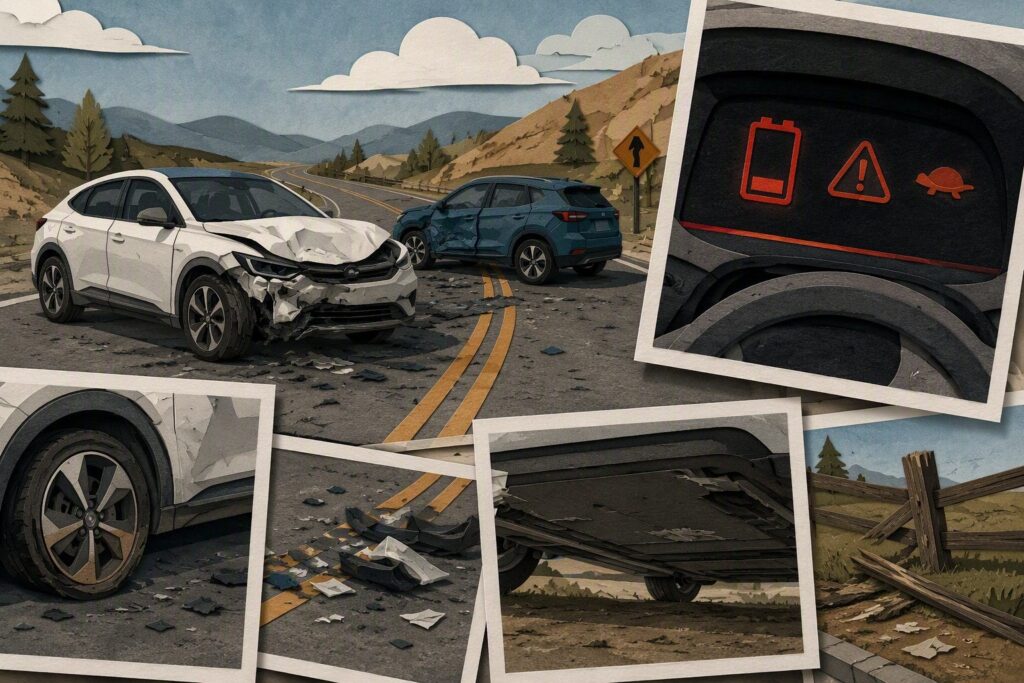
Knowing what to photograph after an EV accident can support your insurance claim and give responders a record they may not be able to recreate later. Work from a safe standing position and cover the following:
- Wide views of the road, vehicle positions and traffic controls.
- Exterior impact points, debris and visible tire or wheel damage.
- Dashboard warnings captured before the display shuts down, if staying near the vehicle is safe.
- Underbody or battery-enclosure damage visible from a standing position.
- Skid marks, road conditions and nearby property damage.
- The other vehicle’s plate, insurance information and visible damage.
- Damaged charging connectors or cables, photographed without moving them.
Documentation never justifies crawling under the EV or approaching smoke for a photo. If conditions are unsafe, leave the images to the police or tow operator.
Preserve the original files with their metadata intact, and don’t edit your only copies.
7. Preserve Records and Report the Collision
Reporting an EV accident in Wyoming, as it does in many locations, starts with a phone call and a file folder. Keep the police incident number and your medical records. Add the towing destination and your insurer communications as they accumulate. Put your photographs and any battery warning shown by the vehicle or its app in the same file. Ask the tow operator to record where the EV will be stored and whether they reported battery damage.
In our example, Wyoming law reinforces the paperwork. Wyoming Statutes § 31-5-1105 requires a driver involved in a collision resulting in injury, death or vehicle damage that prevents normal and safe operation to give immediate notice to the nearest law enforcement agency. Check your current local statutory text because the law may change, and the facts of each collision differ.
8. Arrange Manufacturer-Approved Towing and Storage
How to tow a crashed electric car depends on the model. Give the tow operator the exact make and model, and be clear about the drivetrain configuration. The operator should consult the manufacturer’s official towing or emergency-response guide before moving the vehicle.
Don’t assume a flatbed is the only answer, and don’t assume conventional wheel-lift towing is acceptable. Many EVs require a flatbed or dollies to keep specified wheels off the pavement because turning driven wheels can damage components or generate electrical current in some vehicles. Approved methods differ by model.
Before towing begins, disclose any battery or high-voltage warning, smoke, heat or popping sounds you observed. Also report underbody intrusion, floodwater exposure, airbag deployment and any charging-port or cable damage.
Until qualified personnel assess the vehicle, keep it off the charger and out of your home garage. Follow any storage-distance recommendation in the model’s official emergency-response guide or from the fire authority on the scene.
The tow receipt should identify the storage facility by name. It should also name the person you told about the possible battery damage.
How Do You Know Whether a Crashed EV Is Still Dangerous? Can Battery Trouble Appear After the Vehicle Has Been Towed?
Yes. Physical damage to a lithium-ion pack can lead to delayed heating, which is why tow and storage personnel need to hear about any underbody strike and any warning or smoke you observed at the scene. NHTSA’s post-crash guidance identifies damaged high-voltage batteries as a potential delayed-hazard concern until professionals clear them.
Don’t visit the storage lot to check the battery yourself. Leave questions about monitoring and isolation to trained responders, the tow facility or the manufacturer.
Should You Restart or Charge the EV if It Looks Normal?
No. A normal-looking exterior doesn’t clear the battery pack when the crash involved a battery warning or an underbody impact. The same caution applies after smoke or unusual heat and after damage involving the charging system or exposed electrical components.
A qualified technician or the manufacturer’s designated service provider should decide whether the vehicle can be energized. Warning lights that disappear on their own don’t prove that the vehicle is safe.
Can You Retrieve Belongings From the Vehicle?
That depends on the scene and the vehicle’s condition. If the EV has been isolated at a storage facility, get permission from the facility before entering it. The same rule applies while police or fire personnel still control the scene.
While heat, smoke or any electrical symptom continues, the step 2 rule holds: stay out of the vehicle. Afterward, ask authorized personnel to retrieve essentials such as keys or medication when conditions allow.
Are Electric Vehicles Safer in a Collision?
That depends more on the model than on the powertrain. Modern EVs must meet the federal motor-vehicle safety requirements that apply to other new vehicles, and crash performance varies by model.
A low-mounted battery can lower the center of gravity and improve rollover performance. Outcomes also depend on vehicle mass and structure, restraints, and crash compatibility. For model-specific claims, check the current IIHS vehicle ratings or NHTSA’s crash-test results before drawing conclusions. Ratings change with the model year and test program, so broad rankings may not guide a crash victim.
Does an EV Create a Special Health Risk for Occupants?
Normal EV use doesn’t expose occupants to an open high-voltage circuit. After a serious collision, the immediate health concerns are crash injuries and smoke exposure, along with contact with damaged electrical components or leaked material.
Anyone exposed to smoke or experiencing symptoms should seek medical evaluation.
A Safe Handoff Matters More Than a Close Inspection
Your role at an EV in Wyoming or anywhere is narrower than it may feel in the moment. Protect people first. Report the danger signs you can see, and preserve the records that insurers and repair facilities may request. Battery inspection and electrical isolation belong to trained responders, and towing decisions belong to operators using manufacturer guidance.
The last piece you control is the handoff itself: confirm the tow destination and pass the battery warning along to someone by name. After that, the vehicle is in the hands of people trained to handle it.
