
This article may contain affiliate links.
Deciding whether to repair or replace one of the nation’s eight million fleet vehicles comes down to a hard math calculation: when the total operational cost of ownership exceeds the residual value, you stop fixing it. Fleet managers who rely on emotional attachments or simple gut feelings burn thousands of dollars annually in unexpected maintenance and vehicle downtime.
Repairing a vehicle makes sense as long as its long-term reliability remains intact and the cost of repairs stays under critical financial boundaries. Once a vehicle enters a constant breakdown cycle, the balance rapidly shifts toward replacement.
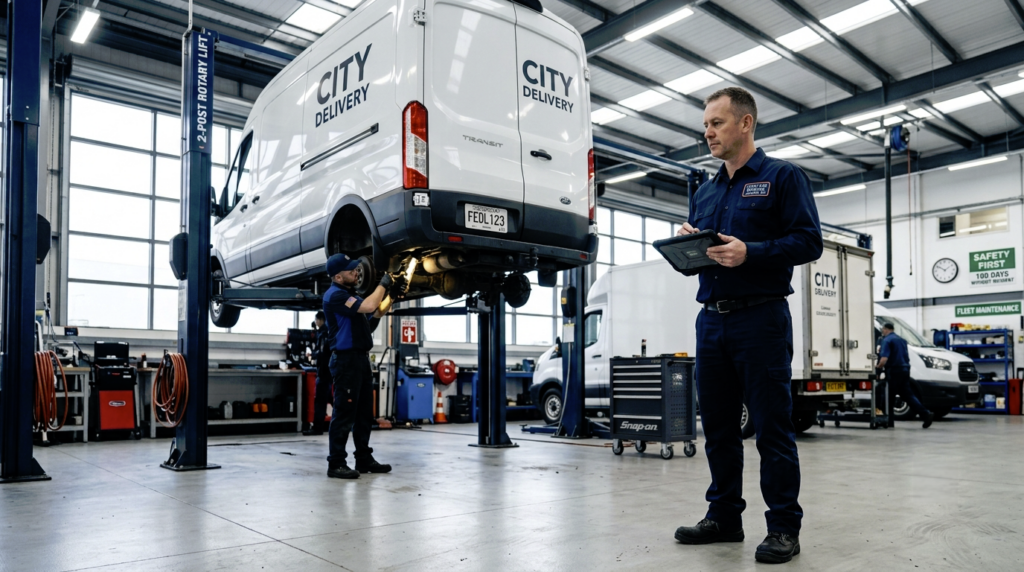
The Financial Thresholds for Fleet Vehicle Repair
There are roughly 150 fleet breakdown events every day across major U.S. commercial routes, each causing costly delays for businesses. When a vehicle breaks down, the cost extends far beyond the mechanic’s invoice. You have to account for lost driver hours, missed client SLAs and towed inventory.
To determine whether a repair is worth the investment, apply the 50/30/20 rule to your current fleet budgets. If a single repair job exceeds 50% of the vehicle’s current fair market value, replacement is almost always the smarter financial path. Similarly, if your annual maintenance spending on essential jobs tops 30% of the vehicle’s total value, or if total operational costs spike by more than 20% year-over-year, the asset is actively eroding your bottom line.
A good rule of thumb is to track the cumulative cost of maintenance over the last 12 months. If that dollar figure surpasses the vehicle’s actual cash value, keeping it in rotation is a losing strategy.
Key Factors to Evaluate Before Authorizing Repairs
Before signing off on major engine overhauls or transmission swaps, evaluate these key operational metrics:
- Unexpected downtime that costs your team more than $500 per day in lost revenue
- Safety system failures or structural frame integrity issues that raise liability risks
- Severe depreciation trends that push the vehicle’s resale value close to or below its estimated salvage value
When a vehicle reaches the end of its useful lifecycle, continuing to pour money into structural or mechanical overhauls often yields little return. At this stage, fleet operators should compare repair costs against the vehicle’s estimated salvage value before deciding whether liquidation is the better financial option.
Evaluating a vehicle using a Cash for Cars salvage breakdown or an equivalent valuation resource helps fleet managers understand how salvage value is determined based on the vehicle’s condition, usable parts, scrap metal value and current market demand. Establishing this baseline before authorizing major repairs can prevent spending $3,000 on an asset that may only have $1,500 in recoverable salvage value. Setting clear repair limits helps keep fleet capital available for more strategic vehicle upgrades.
Downtime and Operational Impact Analysis
Direct repair invoices rarely tell the whole story. The true enemy of fleet profitability is unbudgeted vehicle downtime. A delivery truck or service van sitting in a shop bay yields zero revenue while fixed costs like insurance and licensing keep ticking.
When analyzing downtime, measure the cost of driver displacement and rental fleet supplements. If a breakdown forces you to lease a temporary vehicle at $120 a day while paying an idle driver, your effective repair bill doubles instantly. Industry data reveals that daily fleet downtime costs ranges from $448 to $760 per vehicle when factoring in lost productivity and short-term rentals.
Track these numbers closely across your operations. If a specific vehicle logs more than 15 calendar days of unscheduled downtime in a single quarter, the impact on workflow outweighs any savings from avoiding a new vehicle purchase.
Tax Advantages and Depreciation Considerations
Tax strategy plays a major role in the timing of the fleet lifecycle. Repair expenses are fully deductible in the year they occur, providing immediate operational tax relief. Capitalizing a brand-new fleet replacement requires managing long-term depreciation schedules, such as Section 179 or bonus depreciation allowances.
While immediate write-offs for repairs look attractive on quarterly cash flow statements, they can mask severe underlying asset decay. Repairing an aging asset makes sense late in the tax year if you need immediate deductions and the vehicle is structurally sound. However, relying on repairs solely for tax write-offs leads to holding onto unreliable assets past their functional prime.
Consult with your financial team to weigh immediate maintenance write-offs against capital expenditure write-offs. Balancing these strategies ensures you upgrade assets when tax laws maximize your return while keeping operating expenses predictable.
When Liquidation Beats the Repair Shop
Every vehicle eventually reaches an inflection point where it transitions from a productive revenue generator to a financial liability. Once repairs become chronic, holding on to the vehicle lowers overall fleet utilization and drags down company performance metrics.
Recent commercial market data shows rising component failure costs across medium vehicles make late-stage repairs riskier than in previous years. High component costs mean a single major failure can wipe out an entire quarter’s profit margin for that specific unit.
Replacing an aging vehicle lets you capture high trade-in or salvage values before the asset suffers catastrophic failure. Establishing strict replacement triggers based on age, mileage, and total cost of ownership removes guesswork from the equation.
Building a Predictive Replacement Framework
To avoid emergency decision-making, establish clear replacement metrics across your entire fleet. Modern fleet management software tracks telemetry, maintenance history and fuel efficiency trends to pinpoint the exact crossover point where keeping a vehicle becomes unprofitable.
Fleet managers who rely on real-time data know precisely when an asset transitions from cost-effective maintenance into a money pit. Setting hard boundaries around downtime, repair ratios and safety benchmarks guarantees your fleet operates cleanly, safely and within budget.
Reviewing operational metrics monthly helps keep your fleet lean, efficient and profitable year after year. Exploring detailed asset management strategies on our fleet management blog helps teams refine their maintenance limits and optimize fleet turnover cycles.
